Toronto permit data
How long does a building permit take in Toronto? Real timelines
Published July 24, 2026
The short version
- Ontario law sets business-day review clocks by building type, but the clock only starts once the City deems your application complete.
- In Toronto's own permit record, the wait from application to issuance is driven far more by what you are building than by where you are building it.
- A minority of applications wait far longer than the middle of the pack, so plan around the tail, not the target.
- Every figure on this page is an observed issuance lag among permits currently on record, not a service commitment from the City.
How long does it take to get a building permit in Toronto?
Short answer: Half of the 30,995 Toronto building permits issued in the trailing twelve months and currently on record were issued within 29 days of application, and one in ten waited longer than 177 days as of Oct 9, 2026. The legislated review clock is far shorter than that, but it only starts once your application is complete.
There are two honest answers to this question: what the law requires, and what the City's own permit record shows actually happening. Most pages give you only the first. PermitIndex computes the second directly from Toronto's open permit data, because every permit carries both an application date and an issue date, and the gap between them is measurable. This guide gives you both answers and, more usefully, explains the machinery that decides which end of the range your project lands on.
Issuance lag: the number of days between the application date and the issue date the City recorded for a permit. It is an observed outcome among permits currently on record, not a processing commitment, and it is the number this page means by "wait."
What review timeline does Ontario law require?
Ontario's Building Code requires municipalities to review a complete permit application within a set number of business days, and Toronto sorts applications into review streams by building type. As the City currently publishes them, the review streams run ten business days for a house, fifteen for a small building, twenty for a large building, and thirty for a complex one. Check the City's page for the current definitions, because the stream boundaries follow the Building Code's parts, not intuition: a garden suite rides in the house stream, while a small commercial renovation does not.
The load-bearing phrase is "complete application." Toronto's published position is blunt: an application without an issued zoning certificate is incomplete, and there is no review time frame for incomplete applications. None. The legislated clock is real, but it measures the City's first technical review of a finished file. It does not measure your project's calendar.
How long do Toronto permits actually take by project type?
The observed answer varies enormously by what you are building. The table below renders live from the City's permit record: median and ninetieth-percentile issuance lag by trade, among Toronto permits issued in the trailing twelve months and currently on record as of Oct 9, 2026.
| Trade | Median wait | 90th percentile | Permits, trailing twelve months |
|---|---|---|---|
| New build | 58 days | 520 days | 2,945 |
| Demolition | 43 days | 229 days | 1,640 |
| HVAC | 34 days | 192 days | 4,654 |
| Addition | 32 days | 166 days | 5,021 |
| Electrical | 32 days | 92 days | 95 |
| Pool | 31 days | 141 days | 173 |
| Plumbing | 27 days | 232 days | 6,685 |
| Roofing | 25 days | 123 days | 540 |
| Interior alteration | 24 days | 91 days | 4,540 |
| Deck | 21 days | 119 days | 1,533 |
| Window / Door | 11 days | 61 days | 905 |
Groups with fewer than 30 permits are omitted; a median over a smaller sample is noise.
Quotable: In Toronto's permit record, what you are building predicts your wait far better than where you are building it. Cross-sectionally, new construction sits at the slow end at several times the median wait of window and door work, a gap no dataset artifact explains.
Read the ninetieth-percentile column as seriously as the median. The median is the middle of the pack; the ninetieth percentile is the tail, and one in ten applications lives there. If your renovation financing or your contractor's start date depends on the permit, budget against the tail, not the median. You can watch the fast and slow ends of this table in the live record: window and door permits in Toronto at one end, new construction permits at the other, and the full breakdown by trade and area on the Toronto permit wait times page.
Why do real waits run past the legislated clock?
The gap between a ten-business-day promise and the observed medians has three main causes, and none of them is the plans examiner sitting on your file.
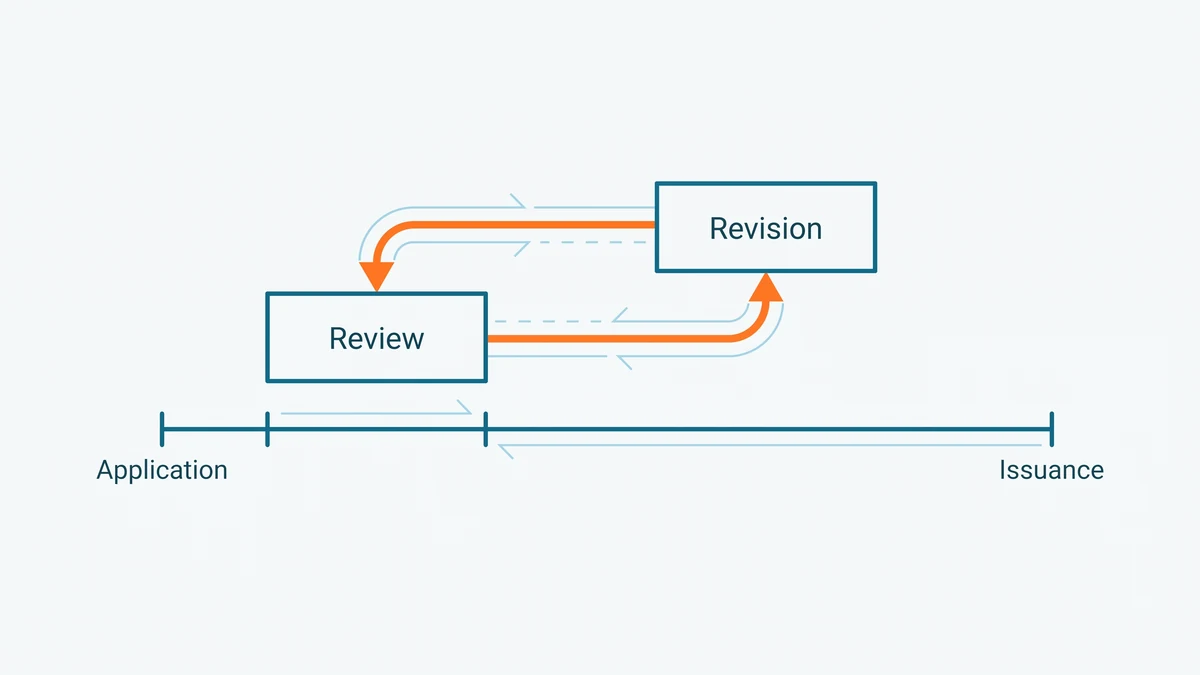
First, the clock starts late. Toronto requires a zoning review before the building review, and until that certificate is issued your application is incomplete, with no review time frame attached. For projects with any zoning wrinkle, this stage can dominate the whole timeline.
Second, the revision loop. If review finds deficiencies, you get a notice, you revise, you resubmit, and the file re-enters review. Each loop adds weeks of calendar time the legal clock never counts. Incomplete or non-compliant drawings are the most common trigger, which is why what Toronto requires in permit drawings is worth reading before you submit, and why revisions and resubmissions have their own guide.
Third, scope. A complex project simply has more to review, more agencies to touch, and more ways for one open item to hold the file. That is visible in the table above: the ranking by trade is stable even as the exact day counts drift with the data.
How do you keep your application on the fast path?
You cannot control the queue, but submission quality is in your hands, and the record suggests it is the difference between the fast half and the slow tail. The working checklist:
- Settle zoning first. Get the zoning certificate the City requires before the building application, and confirm the current sequence on the City's apply for a building permit page.
- Submit complete, code-referenced drawings. The revision loop is the main tail-maker, and it is mostly avoidable.
- Answer the examiner fast. A deficiency notice that sits in your inbox for three weeks is three weeks added to your project, not the City's.
- Track the file. Follow your application in the City's status tool, and see our guide to checking a Toronto permit's status for how to read what you find.
- Plan for the tail anyway. Set contractor dates and financing against the ninetieth percentile for your project type, and treat anything faster as schedule found, not schedule promised.
For the full sequence from documents to issuance, the step-by-step guide to applying for a building permit in Toronto covers each stage, and permit inspections covers what the timeline looks like after issuance. To see what real projects like yours have filed and how long they sat, search any Toronto address in the live record.
How these numbers are calculated
The wait figures on this page are computed live from the City of Toronto's open dataset of active building permits. Each permit's wait is the number of days between its recorded application date and its issue date. The citywide figures come from the seo_wait_citywide function and the by-trade table from seo_wait_by_trade, both of which compute the median and ninetieth percentile in SQL over permits issued in the trailing twelve months, drop records where the issue date precedes the application date, and report a group only when it holds at least thirty permits. Below that floor a median is noise, so the group gets no number rather than a caveated one. We publish medians, never averages, because a handful of very large projects run for years and would drag anything computed as an average far above what most applicants experience.
Two limitations bound every number here. The City publishes currently active permits, and records leave the dataset as projects close out, so these figures describe permits presently on record inside a twelve-month window, not a historical census, and they are Toronto-only. And they are observed issuance lags, not a service standard: the City's legislated review clock is defined on its own terms, linked above. For the underlying dataset and licence, see the data sources page.
Frequently asked questions
- Does the review clock start as soon as I submit my application?
- No. The legislated review period applies to complete applications, and Toronto treats an application as incomplete until every required piece is in place, including the zoning certificate the City requires first. The City states there is no review time frame at all for incomplete applications, so the practical clock starts when your file is complete, not when you first press submit.
- Why is the observed wait longer than the legislated review period?
- The legislated period covers the City's first review of a complete application. The wait measured in the permit record runs from application to issuance, so it also absorbs the time spent completing the file, correcting deficiencies, and resubmitting revised drawings. Each of those loops adds calendar time that the legal clock never counts.
- Can I start construction while my permit application is under review?
- No. Starting work before the permit is issued is an offence under Ontario's Building Code Act and can bring orders, fines, and complications when you later sell. If your timeline is tight, the safer lever is submission quality, since complete applications move through review fastest. Confirm current requirements with Toronto Building before scheduling any work.
- Does hiring a designer or architect make the permit come faster?
- There is no fast lane for professionally prepared applications, but complete, code-compliant drawings are the single biggest factor in avoiding the revision loop, and that loop is where most of the long waits come from. A qualified designer earns their fee by getting the file through review on the first pass, not by skipping the queue.
- How do I find out where my application currently stands?
- Toronto publishes the status of every application, so you can follow your file from submission to issuance rather than waiting for a call. Check it through the City's online application status tool, or look the property up by address to see everything on record for it.