Toronto permit data
How to Get a Minor Variance in Toronto
Published October 14, 2026
The short version
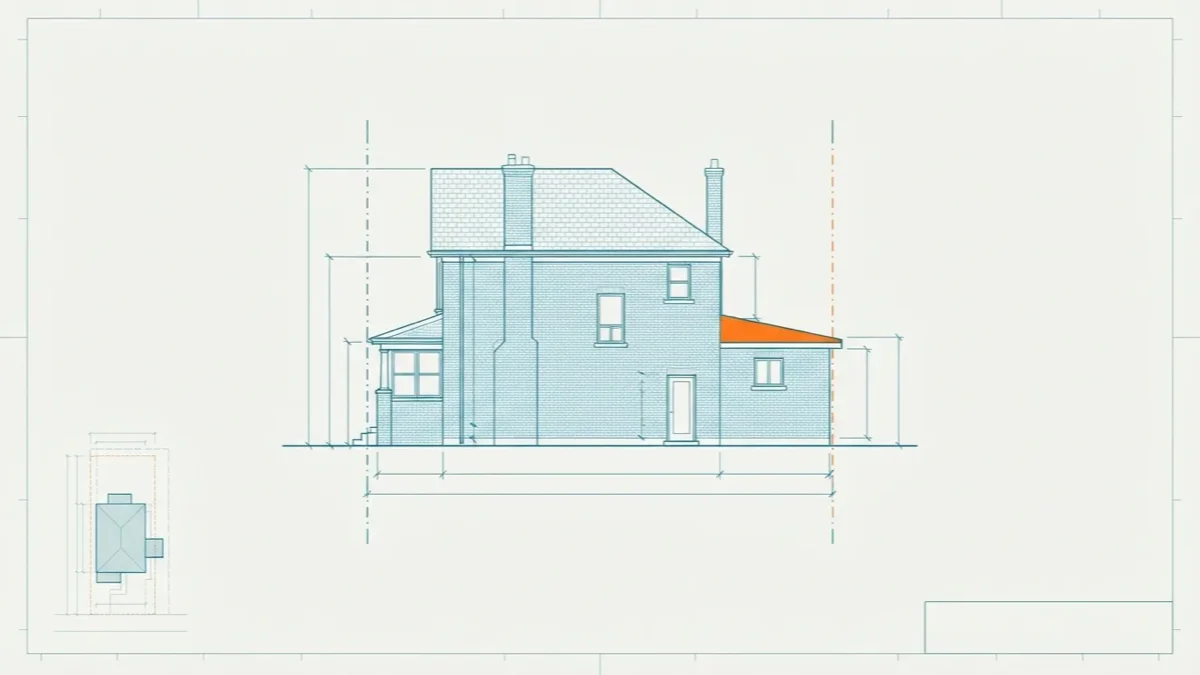
- A minor variance is permission to depart slightly from a rule in Toronto's zoning by-law, such as a setback or a parking rule. The Committee of Adjustment decides it at a public hearing.
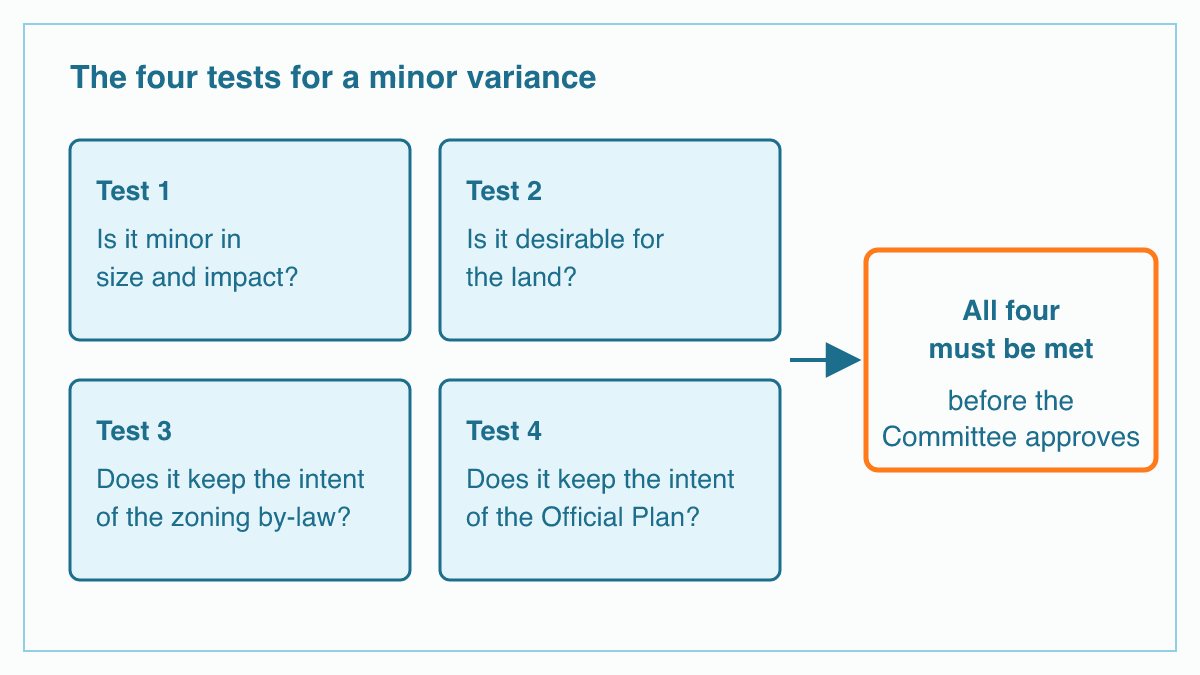
- The Committee must find that the variance is minor, suits the land, keeps the intent of the Zoning By-law and keeps the intent of the Official Plan. All four tests must be met.
- Applications go to the City by email, as PDF files. New application forms took effect on October 1, 2026.
- Nearby owners get mailed notice, and a sign goes up on the property. Only the applicant and a few others named in the Planning Act can appeal, and the deadline is short.
- Once the decision is final and binding, you hand it to Toronto Building, the City's building permit division, with your permit application.
What is a minor variance in Toronto?
Short answer: A minor variance is permission to depart slightly from a rule in Toronto's zoning by-law. That by-law sets how land is used and where buildings sit. You apply to the Committee of Adjustment, which holds a public hearing and decides. The City's Committee of Adjustment page lists "applications to vary zoning rules (Minor Variance)" among the matters it decides.
The power comes from section 45(1) of Ontario's Planning Act. It lets the committee authorize a "minor variance from the provisions of the by-law." The owner can apply, or "any person authorized in writing by the owner."
The City's about the Committee page draws the line. A rezoning is for "major revisions to the Zoning By-law such as land use changes or significant increases in permitted building heights and development densities." Minor variances "are used for issues such as small changes to building setback or parking requirements." A setback is the required distance between a building and a lot line.
Our guide to building permits vs zoning approval explains how the two reviews differ.
What are the four tests?
Section 45(1) of the Planning Act does not number them. It allows a variance that the committee finds "desirable for the appropriate development or use of the land, building or structure." The committee must also find that "the general intent and purpose of the by-law and of the official plan, if any, are maintained."
The City turns that into four tests. Its about the Committee page says the Committee must be satisfied that:
- "The general intent and purpose of the City's Official Plan is maintained." That is the City's long-range land use plan.
- "The general intent and purpose of the City's Zoning By-law is maintained."
- "The proposal is appropriate for the development of the land and/or building."
- "The variance requested is minor."
The Committee's Participation Handbook calls Committee Members "the decision-makers in the Committee of Adjustment process." It adds: "All four tests must be met for Members to approve an application." On size, Members "consider the size, but especially the impact, of a proposed variance," and "small numbers do not necessarily mean small impact."
How do you apply?
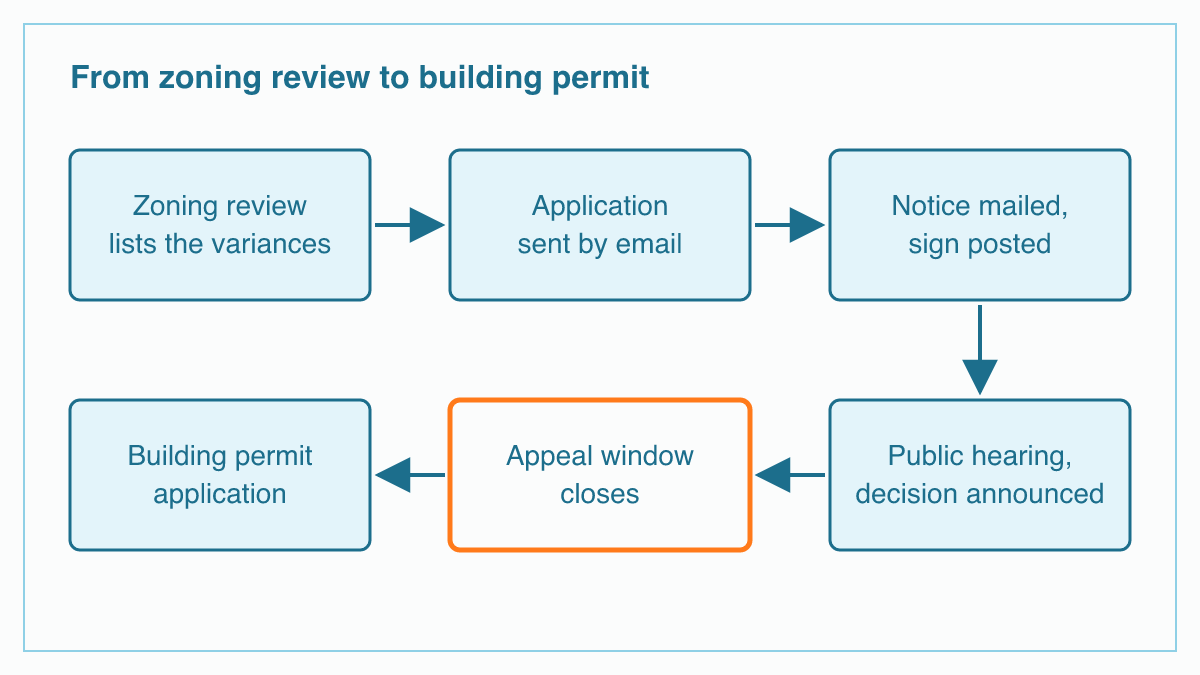
Start with a zoning review. The City's about the Committee page says a zoning review by Toronto Building, the City's building permit division, "is strongly recommended." The examiner's notice "will list all applicable minor variances and other applicable law requirements." Toronto Building offers this review as a Zoning Applicable Law Certificate.
You can skip it. But then you must list the variances yourself and "sign a waiver form assuming responsibility" for getting them right, the about page says. The handbook warns you "may have to reapply and pay the application fees again" after a mistake. See our guides to checking a property's zoning and home additions.
The City's forms and fees page says "applications can only be submitted by email." Send PDFs to bldapplications@toronto.ca with the property address in the subject line. From October 1, 2026, the form is split into Form A, the Application Form, and Form B, the Schedule to the Application Form. The page says "Both forms are required." Old forms are accepted "until October 31, 2026."
The same page sets tree rules. Every application needs a Tree Declaration Form and current colour photos of the whole front and rear yard, "regardless of if there are trees." Protected trees on or within 6 metres of the site need photos too (12 metres in ravine and natural feature protected areas). A site plan must show them.
What does it cost?
The City's forms and fees page lists these minor variance fees, as published, effective January 1, 2026:
- additions and alterations to existing dwellings with three units or less: $2,228.98,
- residential dwellings with three units or less: $5,011.08,
- all other residential, commercial, industrial or institutional uses: $6,485.59,
- after-the-fact variances, for work already built: "double the regular fee."
The page says 80% of the fee "may be refunded" on withdrawal before internal circulation, when staff send the file to City divisions for comment. After circulation but before the hearing notice is mailed, the figure is 50%. It says "There shall be no refund for withdrawal of an application once a Notice of Hearing has been mailed." The handbook adds that you must pay "within 5 business days to avoid having your application cancelled."
The Zoning Applicable Law Certificate page lists $644.38, as published, for a new house of up to two units or for additions, conversions or alterations to a house. Use the completed certificate and the City's declaration form when you apply for the building permit. The page says the certificate's cost then "will be credited to your building permit application fees."
How long does it take?
The handbook says "the main part of the application process typically takes 5 to 8 weeks." The clock runs "from the date Committee staff determine an application is complete to the date of the public hearing," not from the day you send it.
Two stretches sit outside that count. The first comes before it. An applicant "may also spend many weeks or months getting their application ready," the handbook notes. The second comes after the hearing. The written decision follows "within 10 days of the decision being made," the about the Committee page says. The appeal clock does not wait for that letter. For a minor variance, the handbook sets the window at "20 days from the decision date (the public hearing)." Conditions can add more time. There is "no time limit on meeting conditions for a minor variance," the handbook adds.
What happens at the hearing?
The about the Committee page says the City mails a Notice of Public Hearing "to all owners of land within 60 metres of the subject property." It goes out "at least 10 days prior to the scheduled hearing date." The handbook adds: "Through Council direction, we mail Public Hearing Notices 20 days in advance of a hearing."
The sign the City sends you must stay "visible from the street for 10 days prior to the hearing," the about page says. If it is not, "your application may be deferred," meaning postponed.
Written comments are due by "4:30 p.m., five business days before the hearing date," says the City's participate at a hearing page. The applicant, or someone hired to speak for them, goes first. They get "five minutes to make their presentation and another five minutes to rebut comments made by interested parties."
The page says the Committee cannot consider "Aspects of the proposal that do not require variances." It also excludes noise, pollution, property maintenance, construction or engineering concerns. The Members "will announce their decision at the hearing and will state conditions of approval, if imposed." Under the handbook, they may approve, approve with conditions, approve in part or refuse.
Who can appeal the decision?
Section 45(12) of the Planning Act names who may appeal: "The applicant, the Minister or a specified person or public body that has an interest in the matter." They must file "within 20 days of the making of the decision." The Act's list of specified persons names electric and gas utilities, NAV Canada and pipeline operators. Some railway, telecommunication, propane and airport operators are on it too. So are some Aggregate Resources Act licensees and environmental approval holders. Under the Act, a public body is "a municipality, a local board," a hospital or a government body. That last group covers any "ministry, department, board, commission, agency or official of a provincial or federal government or a First Nation." For these appeals, the Act leaves out Ontario ministries other than Municipal Affairs and Housing.
In Toronto, most of these appeals go to the Toronto Local Appeal Body (TLAB), which City Council created in 2017 with locally appointed members. The City's filing an appeal page says the narrower list of appellants has applied since November 28, 2022. That page adds one exception. If the property already has a related appeal at the Ontario Land Tribunal, the appeal goes there instead. That is the tribunal the Planning Act names for these appeals. You file a Notice of Appeal (Form 1) as a PDF with the Committee's Manager and Deputy Secretary-Treasurer. The page states "A $300 appeal fee is due for each appeal filed," as published.
The handbook is blunt: "Neighbours cannot appeal a decision directly." They may ask for party status, formal standing in the appeal, if a public body such as the City appeals.
What comes after, and where are decisions posted?
If nobody appeals, the about the Committee page says "the decision is final and binding" and the City confirms in writing. Then: "provide copies of the committee's decision and the final and binding letter to the Building Division when you apply for your building permit." See applying for a building permit.
The City's tree permit page says that if your plan "directly impacts a protected tree, ravine or natural feature, you are still required to apply for a permit." See our tree permit guide.
To look up an application, the City's more information page points to the Application Information Centre, a searchable list of active applications. Files stay there "for approximately 90 days following a final and binding decision." District hearing agendas are on the agendas and schedules page.
PermitIndex's permit search, which requires signing in, holds Toronto building permits only, not Committee of Adjustment files. It is PermitIndex's own product.
Methodology and limits
This guide carries no permit statistics by design. It draws on eleven City of Toronto documents and one Ontario statute, all read on October 14, 2026. Most City pages show a modified date. The about the Committee page shows October 2, 2026. The forms and fees page shows October 8, 2026. The participate at a hearing page shows December 3, 2025. The more information and tree permit pages both show January 29, 2026. The agendas page shows May 28, 2025. The filing an appeal page shows August 24, 2026. The zoning certificate page shows October 14, 2026. The Committee of Adjustment main page and the Toronto Local Appeal Body page show no date. The Participation Handbook is a PDF posted in September 2026 and marked 2025. The Planning Act web page needs JavaScript, so it was read in the official e-Laws Word download, consolidated from July 1, 2026. Each source is linked where the article draws on it.
Four limits apply. These are Toronto's procedures; other Ontario municipalities set their own rules, so check with yours. The City's pages win where they differ. The handbook's timeline is typical, not a promise. The permit search is PermitIndex's own product, built from the City's open building permit data. What that data covers, and the site's contact email, are on the data sources page.
Frequently asked questions
- What is a minor variance in Ontario?
- A minor variance is permission to depart slightly from a zoning by-law rule. A setback or a parking rule is a common example. Section 45(1) of Ontario's Planning Act lets a committee of adjustment grant one when the owner applies. In Toronto, the City says the committee must be satisfied of four things. The variance must be minor and suit the land. It must also keep the intent of the Zoning By-law and of the Official Plan.
- Can a neighbour appeal a minor variance decision in Toronto?
- Not directly. Since November 28, 2022, only four kinds of appellant are left. They are the applicant, the Minister of Municipal Affairs and Housing, specified persons and public bodies. Specified persons are firms the Planning Act lists, such as utilities and railways. Under the Act, a public body is a municipality, a local board, a hospital or a government body. If a public body such as the City appeals, a neighbour may ask to join. Otherwise, a neighbour can comment or speak at the hearing.
- How long does a minor variance take in Toronto?
- The main part typically takes 5 to 8 weeks, according to the Committee's handbook. That clock starts when staff decide the application is complete. It stops at the public hearing. Preparing the application can take weeks or months before that. A 20-day appeal period then runs from the hearing date. The decision is final and binding only once that period passes with no appeal.
- Do I need a zoning review before applying for a minor variance?
- It is not required, but the City strongly recommends it. A zoning examiner at Toronto Building, the City's building permit division, lists every variance your plans need. If you skip it, you must find the variances yourself. You also sign a waiver taking responsibility for getting them right. A mistake can mean applying again and paying the fees again, the City's handbook warns.
- Can you get a minor variance after the work is already built?
- You can apply, but the Committee does not treat built work as settled. Its Members, the people who decide applications, apply the four tests as if the building had not been built. That comes from the City's handbook. Members may refuse the application. They may then require the owner to take down the new building or structure, or return the property to its original use. The owner pays for that.