Toronto permit data
Do You Need a Hot Tub Permit in Toronto?
Published October 15, 2026
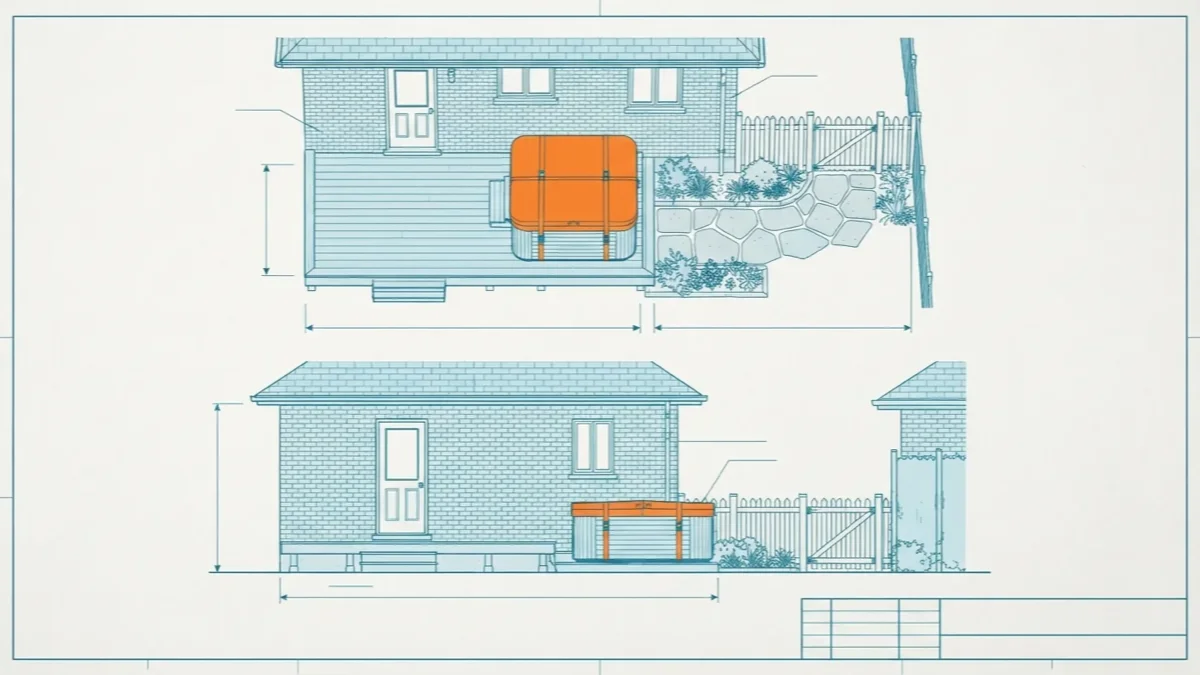
The short version
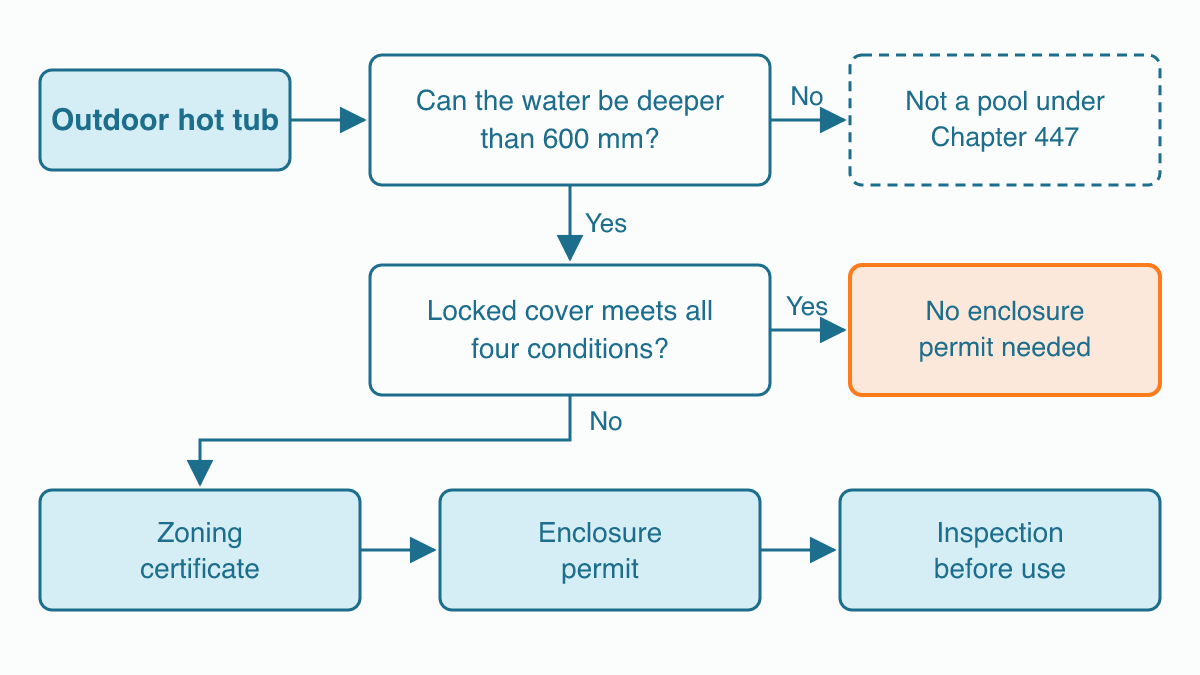
- Toronto's fence by-law, a law passed by City Council, is Chapter 447 of its Municipal Code. It counts an outdoor hot tub as a swimming pool if its water can be more than 600 millimetres deep.
- A hot tub that counts as a pool needs a Pool Fence Enclosure Permit. That is the City's permit for the fence and gates around a pool.
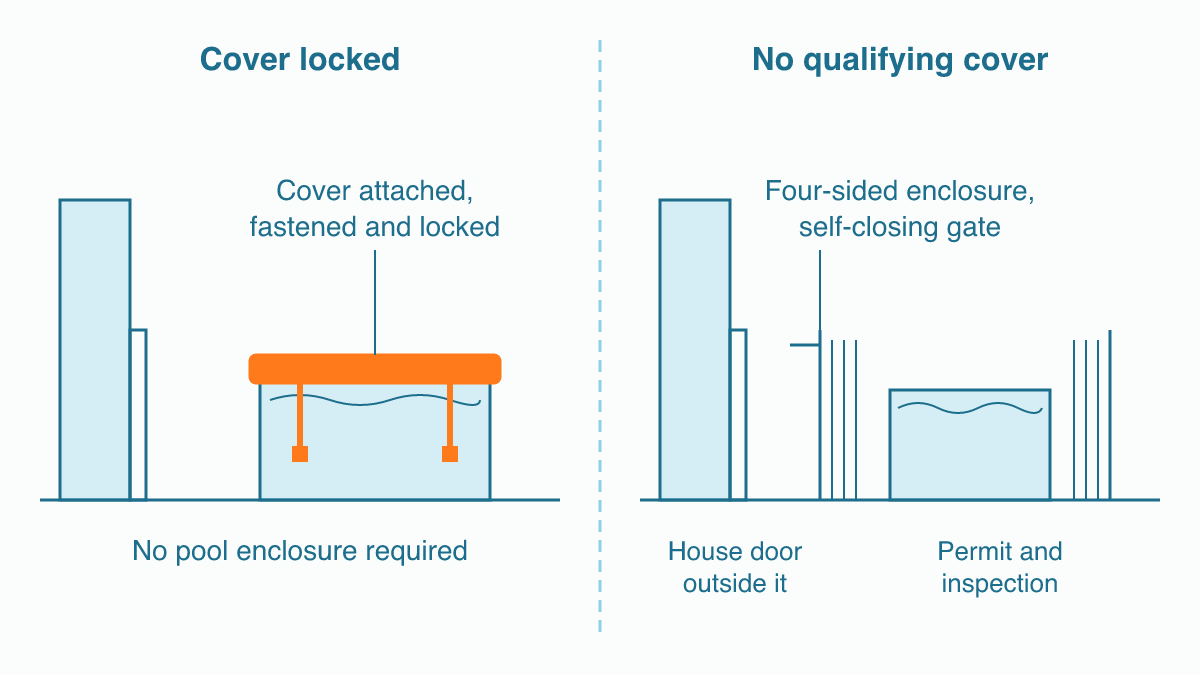
- The exception is a substantial, structurally adequate cover. The by-law says it must be permanently attached, and fastened and locked whenever the tub is not in use.
- Without that cover, the route has two steps. First comes a zoning certificate, a check that the pool fits the zoning by-law, from Toronto Building, the City's building permit division. Then comes the enclosure permit from Municipal Licensing and Standards, the City division that issues it.
- The City pages we read do not say whether a hot tub itself needs a building permit. A deck more than 60 centimetres above ground does need one.
Do you need a permit for a hot tub in Toronto?
Short answer: It depends on the tub's depth and cover. A by-law is a law passed by City Council. Toronto's fence by-law treats an outdoor hot tub as a swimming pool when its water can be more than 600 millimetres deep. Such a tub needs a fence around it and a permit for that fence. The exception is a substantial, permanently attached cover that is locked whenever the tub is not in use. The rules are on the City's fences page and in Chapter 447 of its Municipal Code.
The City's fences page says: "Owners of outdoor swimming pools, hot tubs, whirlpools and other structures that are capable of being used for swimming must apply for a Pool Fence Enclosure Permit." An enclosure is the fence, walls and gates that close off the pool area. The same page adds an exception. A tub needs no permit if it "has a cover permanently attached to it that can be locked to prevent access when it is not in use."
Our pool permit guide covers swimming pools in general. Other Ontario municipalities set their own rules; check with yours.
When does a hot tub count as a pool?
The test is in the definitions of Chapter 447, Fences, the by-law in Toronto's Municipal Code. It defines a swimming pool as an "outdoor structure or thing located on privately owned property." It must be "capable of being used for swimming, wading or bathing." And it is one "in which the water depth at any point can exceed 600 millimetres."
Three parts of that definition matter for a hot tub.
- "Outdoor." The definition covers outdoor structures. The City pages we read say nothing about a hot tub inside a house.
- "Bathing." A hot tub does not have to be big enough to swim in. Bathing is enough.
- "Can exceed." The by-law asks what depth the water can reach at any point.
The fences page words the depth a little differently. On that page, a pool is anything on private property used for swimming, wading or bathing that "is 60 cm (600 mm) deep or more at any point." If your tub is close to that line, ask the City which wording it applies.
What cover lets you skip the enclosure permit?
With the right cover, a hot tub is exempt from the enclosure rules, the permit requirement included. In the by-law's words, those rules "do not apply to a whirlpool, hot tub or spa" with such a cover (Chapter 447, section 447-1.3F(2)). The by-law sets four conditions for the cover:
- it is "substantial,"
- it is "structurally adequate,"
- it is "permanently attached to it or to its supporting structure," meaning the tub or what holds it up,
- it "is securely fastened and locked to prevent access at all times when the whirlpool, hot tub or spa is not in use."
The fences page summary is shorter. It speaks of a cover "that can be locked." The by-law asks that it be locked "at all times" when the tub is not in use.
How do you apply for a hot tub enclosure permit?
If your tub counts as a pool without a qualifying cover, the fences page lists two steps "prior to constructing an outdoor pool or hot tub."
- "Apply for a Zoning Certificate from Toronto Building." Toronto Building is the City division that issues building permits. Per the City's pool permit FAQ, a zoning certificate identifies whether a planned pool complies with the zoning by-law, the rules on what can be built where.
- Apply for the enclosure permit. The page lists the documents to send. They are "A completed Pool Fence Enclosure Permit application form," the zoning certificate and a "zoning approved site plan or drawings" that show the fence. A site plan is a drawing of the lot to scale, seen from above. You email them to the address on that page.
The certificate's full name is a Zoning Applicable Law Certificate. Its City page says it "is required for your application for a Pool Fence Enclosure permit through Municipal Licensing and Standards." That is the City division that takes enclosure permit applications. You can apply for the certificate online, and an application "includes a maximum of three reviews."
Among other items, that zoning page asks the site plan to show the "location of pool equipment" and its "distances to lot lines." Lot lines are the legal edges of your property. As published on the certificate page, the fee is $214.79, effective January 1, 2026.
The fences page also gives a timeline for the enclosure permit. Its site plan reviews "are typically completed within" 10 to 20 business days of a complete application, though "processing times may vary."
What must the enclosure look like?
Chapter 447 sets the rules for any enclosure the tub needs. The height below is for "single residential property," which the by-law defines as land used for no more than two homes in a detached or semi-detached building. The rules include:
- a minimum height of "1.2 metres," from Table 2 of the by-law,
- an enclosure that "completely encloses the area in which the swimming pool is located" and "has no opening except a gate that complies with this article,"
- placement "no closer than 1.2 metres horizontally to the water's edge in the pool,"
- placement at least one metre from anything outside it that "may facilitate climbing," unless it is 1.8 metres or higher for at least a metre either side,
- a design in which "all entrances to any building are located outside the enclosed area,"
- if it is a single gate, one that is "self-closing and equipped with a lockable, self-latching device,"
- a latch "located on the inside near the top of the gate or on the outside at least 1.5 metres above grade," meaning ground level,
- a gate "kept locked at all times except when the enclosed area is in use."
The doorway rule matters most for a tub next to the back door. The fences page gives an example: "a fence is required between the rear door of a house and the pool so that the home does not open into the pool area." This layout "is sometimes referred to as a four-sided pool fence," in the page's words. For general fence rules, see our fence permit guide.
The fence between the tub and the house has one more rule. Section 447-1.3E(3) says it must be "open mesh chain-link fence or equivalent open fence construction." It must not "restrict visibility of the pool" from a door or window in the main living area with a line of sight to the pool. A fence you cannot see through does not meet that wording.
When can you fill and use the tub?
Chapter 447 sets the order. No one may fill a pool until an officer, a City employee who enforces the by-law, has inspected it. The officer must have "confirmed completion of a permanent swimming pool enclosure that fully complies with this article" (section 447-1.3B(7)).
Temporary fencing is the one exception: you "may fill a swimming pool with water when temporary fencing has been erected in compliance with this article." The by-law allows that fencing only "if authorized by the Executive Director or an officer," the Executive Director being the head of Municipal Licensing and Standards. Even then, the pool "shall not be used until permanent fencing has been erected" and an officer has inspected it (section 447-1.3B(4) and (8)).
The fences page tells you to "Contact 311 to book an inspection." It also warns: "If you use your pool before this inspection, you may face a fine." The City's pool permit FAQ, last updated March 24, 2021, adds an earlier step. Before any work under the permit, you must contact the Bylaw Enforcement Officer "for a pre-construction inspection."
Does the hot tub or its deck need a building permit?
Toronto Building's when do I need a building permit page does not mention hot tubs on either list. Its deck guide does not mention them either. No page we read says how much weight a deck must carry for a tub.
What the first page does say applies to the structures around a tub:
- "Construct a deck more than 60 centimetres (24 inches) above ground" is on the list of work that needs a permit.
- An accessory structure is a secondary building that serves the house, such as a detached garage. One larger than 10 square metres, such as a "pool house or cabana," needs a permit too. So does one of any size that is attached to a building or has plumbing.
- "Even if a building permit is not required, compliance with the Zoning Bylaw is required."
The pool permit FAQ is blunt about scope: all proposed accessory buildings and structures "are not included in the scope of the pool fence permit." A deck is one of the structures it names. Our deck permit guide covers the height rule in more detail.
Wiring is a separate approval again. The City's BuildSafeTO page says "almost all electrical work requires an electrical permit from the Electrical Safety Authority (ESA)." That permit, the page notes, "is obtained separately from a building permit."
What if your fence cannot meet the by-law?
The City's fence exemption page lets owners ask their Community Council for an exemption. A Community Council is a committee of City councillors. Citing Municipal Elections Act requirements, that page says Community Council meetings are suspended from August to December 2026. Final decisions will take place starting "in early 2027."
For pools, the same page is plain: "the pool cannot be used until the required enclosure is installed or an exemption is approved by Community Council." On a tight lot, start with our guide to checking a property's zoning.
Where can you check a property's permits?
PermitIndex's permit search, which requires signing in, is our own product. It holds building permits only. A Pool Fence Enclosure Permit comes from Municipal Licensing and Standards under the fence by-law, so do not expect to find one there. For questions on fence rules, the fences page points you to your local Municipal Licensing and Standards district office, or to 311.
Methodology and limits
This guide carries no permit statistics by design. Its rules come from pages read on October 14, 2026. The by-law is Toronto Municipal Code Chapter 447, Fences, whose page footers carry the date June 9, 2021. Six City pages show a "Date modified." Three are Fences (September 8, 2026), the pool fence zoning certificate page (October 9, 2026) and When Do I Need a Building Permit? (July 21, 2026). The other three are the Decks and Porches guide (August 27, 2026), BuildSafeTO (September 17, 2026) and Fence Exemption (June 8, 2026). The pool permit FAQ, a PDF, was last updated March 24, 2021. Each is linked in the section that draws on it. Where a paragraph says "the page" without a new link, it means the page linked earlier in that section.
Three limits apply. These are Toronto's rules; other Ontario municipalities write their own. The FAQ is older than the other pages, so where they differ, rely on the newer City pages and ask the City. And the permit search linked above is PermitIndex's own product, built from the City's open building permit data; it does not hold pool enclosure permits. What that data covers, and the site's contact email, are on the data sources page.
Frequently asked questions
- Do you need a permit for a hot tub in Ontario?
- It depends on the municipality, since each sets its own rules; check with yours. In Toronto, the City's fences page says owners of outdoor hot tubs must apply for a Pool Fence Enclosure Permit. That is the permit for the fence and gates around a pool. The page adds that it is not required if the tub has a cover permanently attached to it that can be locked when not in use.
- Is a locked hot tub cover enough to skip the fence?
- Only if it meets every condition in Chapter 447. The by-law's exception covers a hot tub with a substantial, structurally adequate cover. It must be permanently attached to the tub or its supporting structure, and securely fastened and locked at all times when the tub is not in use. A cover that can be locked but is not kept locked does not match that wording.
- Do you need a building permit to put a hot tub on a deck?
- The City pages we read do not say. Toronto Building's list of projects that need a permit does not mention hot tubs. It does list a deck more than 60 centimetres above the ground. The City's pool permit FAQ adds that proposed accessory structures, meaning secondary structures that serve the house, such as decks or cabanas, are subject to separate building permit applications.
- Can you fill a hot tub before the City inspects the fence?
- Not if the tub counts as a pool and needs an enclosure. Chapter 447 says no one may fill it until an officer, a City employee who enforces the by-law, confirms a permanent enclosure that fully complies. The exception is compliant temporary fencing, allowed only "if authorized by the Executive Director or an officer," the Executive Director being the head of Municipal Licensing and Standards. Even then, the tub may not be used until the permanent enclosure passes inspection.
- Do you need a permit to replace an old hot tub?
- Treat it as a new tub. Chapter 447 says a fence or pool enclosure lawfully built before June 20, 2018 is deemed to comply, or treated as meeting the by-law, until it is replaced. Any replacement fence or swimming pool shall comply with the by-law. So a new tub whose water can exceed 600 millimetres needs either a qualifying locked cover or an enclosure permit.