Toronto permit data
Do I need a permit for a fence, carport, or gazebo in Ontario?
Published July 24, 2026
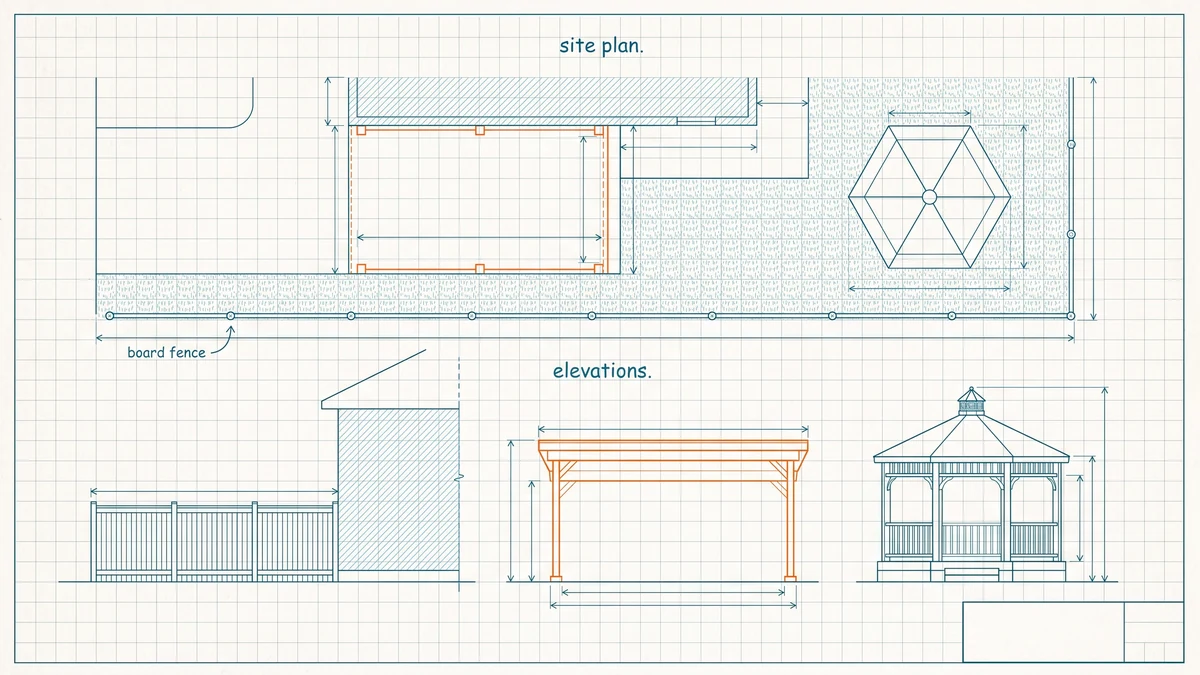
The short version
- A standard fence generally does not need a building permit in Ontario. Municipal fence bylaws control height and materials instead, and a fence around a pool needs its own enclosure permit in Toronto.
- A carport attached to the house is treated as an addition, so it generally needs a building permit no matter how small it is.
- Detached carports and gazebos are judged on footprint. Small ones can fall outside the permit system entirely, but a structure big enough to actually cover a car rarely does.
- Even when no building permit is required, zoning setbacks and lot coverage rules still apply.
Do I need a permit for a fence, carport, or gazebo in Ontario?
Short answer: A regular fence generally does not need a building permit in Ontario, though local fence bylaws still control its height and materials. A carport usually does need one: attached carports are treated as additions, and detached ones cross the line once the footprint is larger than what the law considers a mere structure. A gazebo follows the same footprint test. Confirm your specific project with Toronto Building or your local building department.
These three projects get bundled together in backyard planning, but they sit under three different rulebooks. Fences answer to municipal fence bylaws. Carports and gazebos answer to the Building Code Act, which defines a "building" partly by floor area: a detached structure at or below roughly 10 square metres with no plumbing is generally not a building at all, so no building permit applies. Above that footprint, or attached to the house, or with plumbing, it is a building and a permit generally follows. The rest of this guide walks the line for each structure, and covers what applies even when no permit does.
When does a fence need a permit in Ontario?
Almost never, if it is an ordinary property fence. A fence on its own is not a building under Ontario law, so the building permit system does not reach it. What governs fences is the municipal fence bylaw. In Toronto that is Municipal Code Chapter 447, which caps fence heights (lower in front yards than in back yards), bans certain materials such as barbed wire on residential land, and handles disputes between neighbours. The exact caps and exceptions are in the City's fence bylaw guidance, and other municipalities publish their own versions.
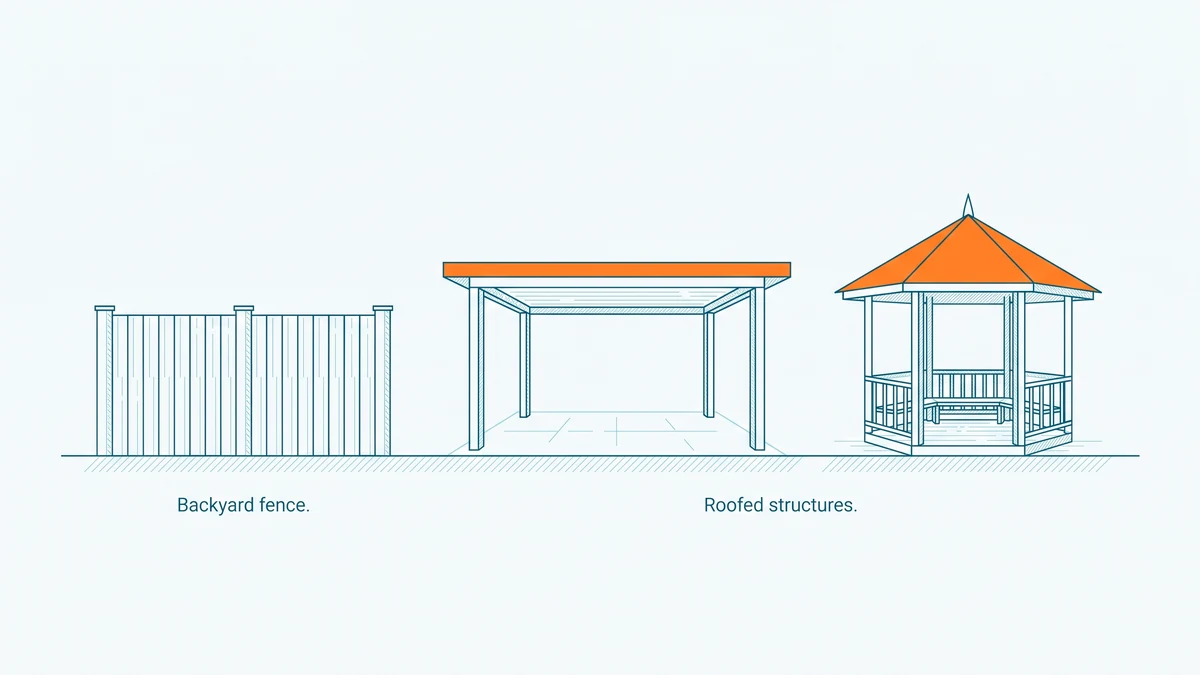
The exception that catches people is the pool. A fence that encloses an outdoor pool is a pool enclosure, and Toronto requires a pool enclosure permit for it, with an inspection before the pool can be filled. That is a separate permit stream from building permits, with its own height and gate-hardware requirements. If your fence project exists because of a pool, treat it as a pool enclosure project from the start and check the City's current requirements before ordering materials.
Do I need a building permit for a carport?
Usually yes, and the reason is geometry. Toronto's published guidance treats a carport attached to the house as an addition to an existing building, which needs a building permit regardless of size. A detached carport is an accessory structure, and the City's guidance lists accessory structures larger than roughly 10 square metres, naming carports specifically, as needing a permit. The catch is that 10 square metres is smaller than a parking space with a roof over it. A detached carport that actually shelters a car will almost always exceed that footprint, which is why the honest general answer is yes, expect a permit, and confirm with Toronto Building before you build.
Quotable: The permit test for a backyard structure in Ontario comes down to three things: whether it is attached to the house, how large its footprint is, and whether it has plumbing. What it is made of, what it cost, and whether it came as a kit are irrelevant.
Two more triggers apply at any size. A structure with plumbing needs a permit no matter how small it is, and attachment to any existing building has the same effect. Prefabricated and kit carports are covered by the same rules as site-built ones.
Do I need a permit for a gazebo?
It depends on the footprint. A small freestanding gazebo with no plumbing, sitting at or below the roughly 10 square metre line, is generally not a building and needs no building permit in most Ontario municipalities. A larger gazebo generally does need one.
One nuance is worth knowing because it confuses people. The current edition of Ontario's Building Code carries a more generous exemption for small detached structures, commonly cited for sheds, that extends to roughly 15 square metres. That exemption is written for one-storey, unattached, plumbing-free structures used only for storage ancillary to the house. A gazebo is not a storage building, so the storage exemption does not stretch to cover it, and the smaller general threshold remains the operative line. If you are weighing a shed instead, the rules are close but not identical, and our guide to shed permits in Ontario walks that version of the test.
Pergolas sit in the same family. An open-roofed pergola below the threshold is generally fine without a permit, but municipalities differ on how they treat large or attached ones, so a call to the local building department before construction is cheap insurance.
What rules apply even when no permit is needed?
Skipping the building permit does not mean skipping regulation. Toronto's guidance is explicit that compliance with the zoning bylaw is required even where no building permit is. Zoning controls where on the lot a structure can sit, how close to the property line it can come, how tall it can be, and how much of the lot all structures together can cover. A permit-exempt gazebo placed against the rear fence can still be an illegal gazebo if it violates a setback.
Fences carry their own bylaw layer regardless of permits, and pool enclosures carry theirs. On some Toronto lots, ravine and tree protection rules add another. None of these show up in a building permit search, because no building permit exists for them. The full picture of which projects need permits, across every common project type, is in our pillar guide to what requires a building permit in Ontario, with the deck-specific version in deck permit rules in Ontario, since a gazebo on a raised deck inherits the deck's permit question too.
What happens if I build one without a required permit?
The common outcomes are an order to comply, an application to legalize the structure after the fact, or removal. Municipal inspectors mostly act on complaints, and a neighbour with a sightline to a new carport is a common source of them. Legalizing after the fact typically means applying for the same permit with the structure already standing, sometimes with engineering work to prove what is hidden.
The quieter cost arrives at sale. Building permits are public records, and anyone can search the Toronto permit record by address, which is exactly what buyers, their lawyers, and their inspectors do. A carport standing on a property with no matching permit in the record invites questions the seller has to answer. Our guide to building without a permit in Ontario covers the enforcement and legalization path in detail.
How do carports and gazebos show up in Toronto's permit data?
Mostly, they do not, and that absence is informative. Structures small enough to be exempt never enter the permit record at all, so the record cannot confirm that a small gazebo was built legally; there is simply nothing to file. The projects that do cross the permit line enter the same citywide flow as every other permit. PermitIndex currently indexes 30,910 Toronto building permits issued in the trailing twelve months as of Oct 9, 2026, drawn from the City's open data, and small accessory structures ride inside broader residential permit categories rather than under a "carport" or "gazebo" label of their own.
That has a practical use. If your carport does need a permit, the observed approval lag for Toronto permits, by trade and by area, is published on our Toronto permit wait times page, which helps with scheduling a build season. And the same record powers per-trade views such as deck permits in Toronto, the closest published category to the backyard-structure family. These figures describe Toronto only; the permit rules above are provincial, but the numbers are not.
How these numbers are calculated
The single statistic on this page is the count of building permits issued in the City of Toronto over the trailing twelve months, computed live by the seo_citywide_12mo aggregate from the City's open dataset of active building permits, and stamped with the newest issue date in that data. It is not a hand-typed figure and it refreshes as the City's record does.
Two limits apply. The dataset covers permits currently on record, and records leave it as projects close out, so it is not a historical census. And it is scoped to Toronto: the permit thresholds discussed above are provincial, but every number here is a Toronto number. Sourcing and licence details are on the data sources page.
Frequently asked questions
- Do I need a permit for a pergola in Ontario?
- Usually not for a small freestanding pergola, because an open-roofed structure with a modest footprint generally falls below the size at which Ontario law defines a structure as a building. Once a pergola is attached to the house, enclosed, or built large, the permit question changes, so confirm the specific design with your municipal building department before you build.
- Does a fence around a swimming pool need a permit in Toronto?
- Yes. Toronto requires a pool enclosure permit for the fence around an outdoor pool, and the City inspects the enclosure before the pool can be filled with water. This is separate from the building permit system that covers structures, so a compliant backyard fence elsewhere on the property still needs no building permit.
- Can I build a carport or gazebo right on my property line?
- Generally no. Zoning bylaws set minimum setbacks from lot lines and limits on how much of the lot a structure can cover, and those rules apply whether or not the structure needs a building permit. Check your municipality's zoning rules before fixing the location.
- Does a prefab or kit carport still need a permit?
- The rules look at size, attachment, and plumbing, not at how the structure was manufactured. A prefabricated carport that would need a permit if built from scratch needs the same permit as a kit. Toronto's guidance applies to prefabricated accessory buildings explicitly.
- Will an unpermitted carport or gazebo cause problems when I sell?
- It can. Building permits are public records, so a buyer, their lawyer, or their inspector can compare what stands on the property against what the record shows. Work that needed a permit and never got one can surface as a condition of sale or a demand to legalize or remove the structure.