Toronto permit data
Sign Permits in Toronto for a Business
Published October 14, 2026
The short version
- Toronto's sign by-law, Chapter 694 of the Municipal Code, bars anyone from putting up a sign without first getting a sign permit. A short list of signs is exempt.
- A sign fixed to a building or set into the ground needs a sign permit and a building permit. Window and painted wall signs that need a permit need only the sign permit, not a building permit, as do topiary signs.
- A shop window sign needs no permit if it meets the City's conditions on electronic display, size, content and height. Window signs are not allowed in residential sign districts.
- A sign that breaks the by-law needs a sign variance before a permit can be issued. City staff decide variances for first party signs, which identify a business on the premises, and their decisions can be appealed.
- An A-frame sign on the sidewalk falls under a different by-law, Chapter 693, and needs its own City permit.
Do you need a permit for a business sign in Toronto?
Short answer: Usually, yes. Toronto's sign by-law, Chapter 694 of the Municipal Code, bars anyone from putting up a sign "without first obtaining a sign permit from the Chief Building Official." A sign installed on a building or into the ground also needs a building permit, the City says. A few small signs are exempt. An A-frame sign on the sidewalk falls under a different by-law and needs its own permit.
The City's sign permits page says a first party sign is used "to identify a business or service located on the premises." A third party sign is used "to advertise goods or services not related to the premises." This guide covers first party signs. Toronto Building, a City division, administers and enforces the sign by-law, the page adds.
Does a sign also need a building permit?
Often, yes. The City's general sign inquiries page says: "Any time a sign is installed on a building or into the ground, a Sign and Building Permit is required." Window signs and painted wall signs are exceptions. So are topiary signs, which are signs made of plants such as shrubs and flowers. The page says these "would not require a Building Permit, but still require a Sign Permit."
Section 694-8 of the by-law adds that a sign permit is not "a substitute for any approval or permission required by law including a building permit."
Which signs do not need a sign permit?
The general sign inquiries page says window signs are allowed in every sign district except Residential and Residential Apartment. A sign district is the zone that sets which sign rules apply to a property. Copy means the words, images and logos shown on a sign. A window sign needs no permit as long as:
- it does not "display copy electronically," such as an LED sign,
- it does not "exceed 25% of the window area,"
- it shows only "first party copy,"
- it is not located "above the second storey of the building."
A window sign that breaks any of these conditions needs a sign variance first, then a sign permit, the page says.
Section 694-6 of the by-law lists other signs that may go up "without obtaining a sign permit," provided "they comply in all other respects" with the chapter. Examples include "A flag, banner, or emblem of a country, province, municipality" and signs of "memorial, commemorative or historical interest" up to 2.0 square metres. Section 694-2 says the chapter does not regulate "a sign within a building other than a window sign."
How do you check the rules for your address?
Start with the sign district. The general sign inquiries page says each one "has its own set of regulations within the Sign By-law." It describes the City's SignView map, which shows the district for an address and "the applicable regulations."
If your sign does not fit the rules, the first party sign permit page says you will need a variance. It tells you to start with a Preliminary Project Review (PPR), a paid early check. The City's PPR page says it "will identify any variances required, Applicable Law approvals or instances of non-compliance with the Sign By-law." That page gives staff 20 days to review a PPR.
How do you apply for a sign permit?
The first party permit page says applications go by email. The first party sign permit page says: "Only electronic applications are accepted, and can be sent via email to expressservices@toronto.ca."
The page marks some forms "Always Required," including a Letter of Authorization from the property owner. Others apply only in some cases. Schedule 1, for example, is needed "when the sign is designed by anyone other than a professional engineer/architect." Our Schedule 1 guide explains that form.
Some signs need another agency's approval first. The page lists the cases, such as a designated heritage property or a sign that encroaches on a public right-of-way. It also says heritage applications "do not qualify for the Express Service 3-day service." Express Services, the timelines page says, is the City team for up to three signs.
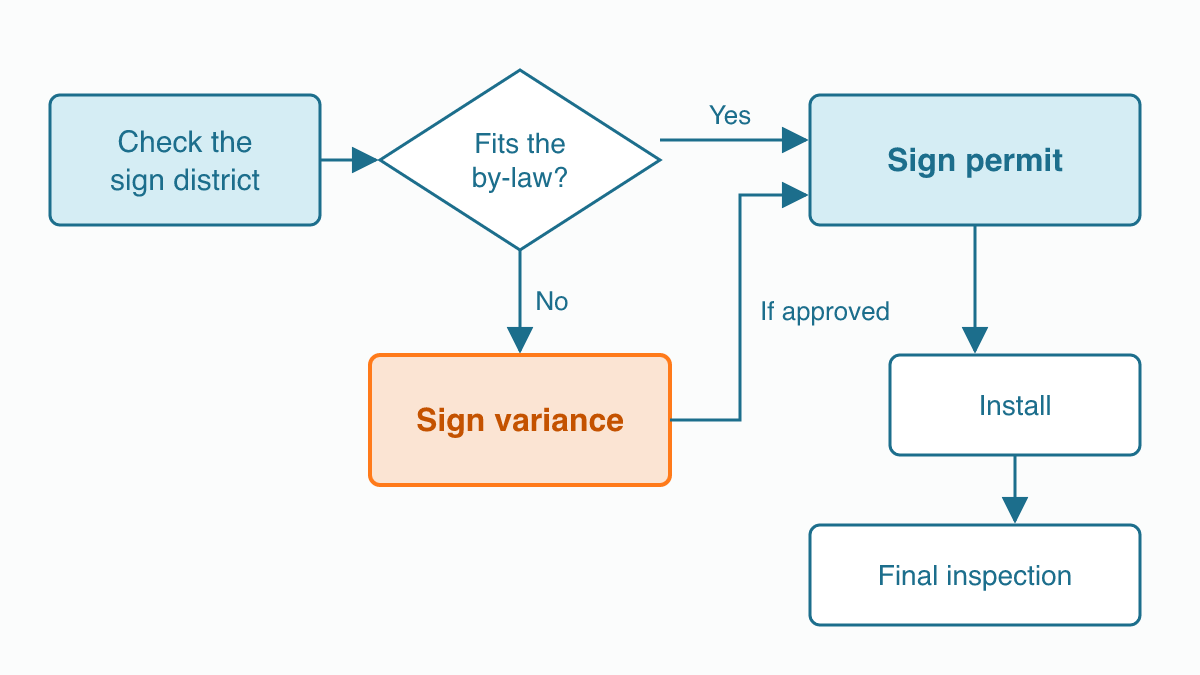
After the sign is up, the sign inspections page says a final inspection is required. The inspector also needs an installer's report to close the permit, unless a professional engineer's report is required instead.
What drawings does the City want?
The first party sign permit page says drawings must be "drawn on standardized sized sheets, drawn to scale, fully dimensioned, signed and dated." It asks for a site plan showing property lines and setbacks, the distances to those lines. For signs on a building, it asks for the "Clearance from grade to the bottom of the sign," meaning the height of its lowest edge above the ground. Our guide to Toronto permit drawings covers drawing standards in general.
How long does it take and what does it cost?
The City's expected timelines page says Express Services reviews applications for three or fewer signs. You get the outcome within three days of a complete submission. Four or more signs go to City Wide Priorities, the City team for larger applications. Its standard timeline is "10 business days" once the file is complete and paid.
The newer general sign inquiries page, modified July 10, 2026, says: "The standard turnaround time for a Sign Permit is 10 business days." It also offers a "Fast Track option for Sign Permits, which has a two-day turnaround," for engineer-stamped files with no deficiencies or extra approvals.
Fees, as published on the first party sign permit page (effective January 1, 2026), are "$37.71 per square metre (minimum of $263.87)" for a wall sign. A separate "Building Permit (DS)" fee is $70.67.
The City's sign-related fees page opens with the all-in minimum, as published: "The minimum fee for a Sign Permit is $334.53, which includes a $70.67 fee for the Building Permit." So DS marks the building permit part of the fee. The general sign inquiries page also gives $334.53. Yet the fees page table lists a wall sign minimum of $253.72, not $263.87. Ask Express Services which figure applies before you pay.
To check status, the inquiries page says "the best way" is to contact your Examiner, the staff member reviewing your file. Our status guide covers the City's online lookup.
What if your sign does not meet the by-law?
You need a sign variance, which is permission to depart from the sign by-law. The City's sign variance page says one "is required before a Sign Permit can be issued" for a sign that does not comply.
The page says a variance may be granted where the sign will:
- belong to a sign class permitted in its sign district,
- be compatible with the development of the premises and surrounding area,
- support the objectives of the Official Plan, the City's main land-use plan, for the premises and surrounding area,
- not adversely affect adjacent premises,
- not adversely affect public safety, including traffic and pedestrian safety,
- not be a sign prohibited by section 694-15B,
- not alter the character of the premises or surrounding area,
- not be, in the Chief Building Official's opinion, "contrary to the public interest."
A ninth test applies only to third party signs. The applicant must show the sign "meets all of these criteria."
For first party signs, staff of the Sign Bylaw Unit decide. Their decision can be appealed "within 20 days" to the Sign Variance Committee, a board of five members of the public. A notice must be posted on site "30 days prior to hearing/decision." Properties within 60 metres and the ward councillor are notified. The timelines page says the process "usually takes around three months."
Can a sign hang over the sidewalk?
Only with a second approval. Section 694-17 of the by-law requires written approval from the General Manager, Transportation Services, before putting up:
- "Any sign located, in whole or in part, in a public right of way,"
- "Any sign which projects, in whole or in part, over a public right of way,"
- a projecting, overhanging structure or topiary wall sign, including electronic versions, within 30 metres of an intersection with traffic lights.
The public right of way is City-owned street land, including the sidewalk.
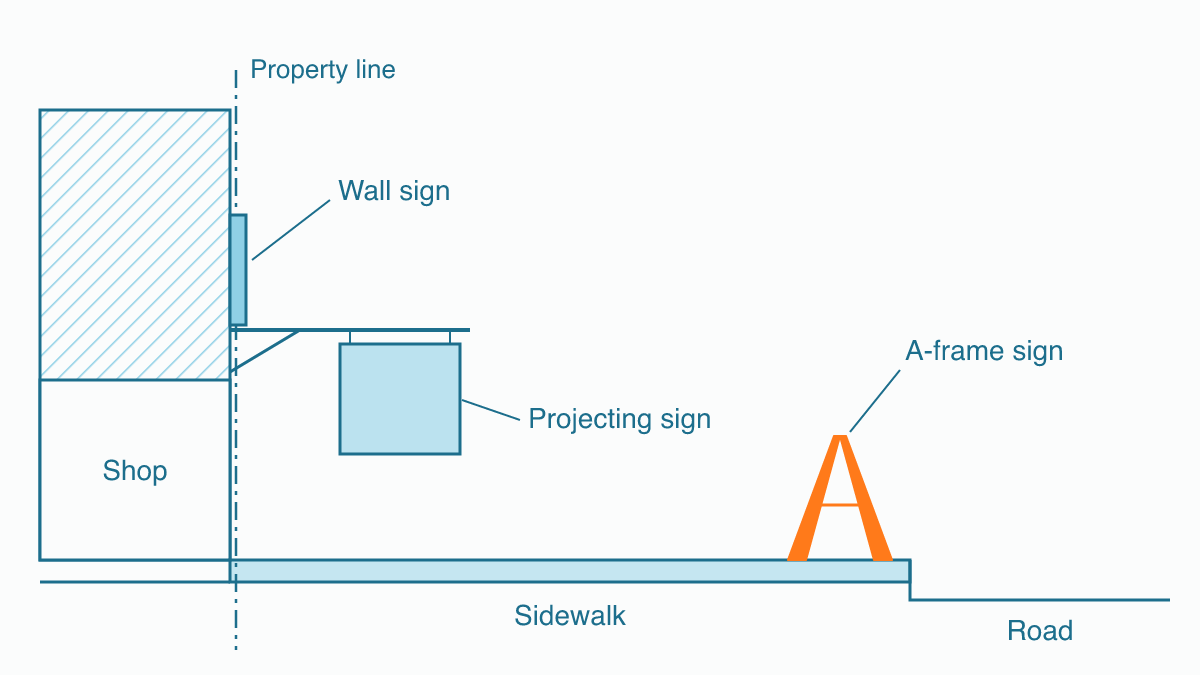
The general sign inquiries page says that once the sign permit is issued, you must get "either an encroachment agreement or other written approval for the sign." That is a contract letting a private object sit on or over City land. And without one, the page warns of possible "revocation of your sign permit." Our Street Occupation Permit guide covers using the street during the work.
Do you need a permit for an A-frame sign?
Yes. The City's A-frame signs page says: "A-frame signs require a permit from the City." The rules sit in section 693-4.3 of Chapter 693, not the main sign by-law. If your business already needs a City business licence, that section calls instead for "an attachment to or endorsement on the applicable business licence."
The A-frame page sets these sign requirements:
- no larger than 0.6 metres wide, 1 metre high and 0.75 metres long,
- on public property only if it cannot go on private property,
- first party advertising only,
- one per business location,
- out only during business hours,
- no illumination, sound or motion,
- the area around it kept free of litter, debris and weeds.
Signs must leave a "2.1-metres pedestrian clearway" on sidewalks, wider on some downtown streets. The page asks for proof of $2 million in liability insurance. As published (page modified August 20, 2026), the fee is $151.32, HST included, and the permit renews each year.
What happens if a sign goes up without a permit?
The general sign inquiries page lists the risks. They are a fine, "issuing a charge to appear in Court, and/or the removal of the sign at the expense of the property owner." The sign-related fees page adds an Administrative Fee per sign face once a Notice of Violation is issued.
PermitIndex's permit search, which requires signing in, is our own product, built from the City's open data on active building permits.
Methodology and limits
This guide carries no permit statistics by design. Every rule and fee above comes from City of Toronto sources read on October 14, 2026, each linked where used. The by-law PDFs for Chapters 694 and 693 are footed June 3, 2024. The first party permit, sign variance and PPR pages were updated February 18, 2026, and the inquiries page July 10, 2026. The fees page was updated December 31, 2025, and the timelines and inspections pages December 19, 2025. The Sign Variance Committee page was updated June 9, 2026, and the A-frame page August 20, 2026. The sign permits main page shows no date.
Three limits apply. City pages differ on the minimum sign fee and on timing, so confirm both before paying. Other Ontario municipalities set their own rules; check with yours. The permit search above is PermitIndex's own product. Its coverage and the site's contact email are on the data sources page.
Frequently asked questions
- Do I need a permit to put up a business sign in Toronto?
- Usually, yes. Chapter 694 of the Toronto Municipal Code says no one may put up a sign without first obtaining a sign permit from the Chief Building Official. The City's sign inquiries page adds that any sign installed on a building or into the ground needs both a sign permit and a building permit. A few small signs are exempt, and so are window signs that follow the City's limits.
- Do window signs need a permit in Toronto?
- Often not. The City's sign inquiries page says window signs need no sign permit if they do not display copy electronically, stay within the City's limit on how much of the window they cover, show only first party copy and sit no higher than the second storey. Copy means the words, images and logos on a sign, and first party copy is about the business on the premises. They are not allowed in Residential or Residential Apartment sign districts. A window sign that breaks a condition needs a sign variance, then a permit.
- Do I need a permit for an A-frame sign on the sidewalk in Toronto?
- Yes. The City's A-frame signs page says these signs require a permit from the City. The rules come from Chapter 693 of the Municipal Code, not the main sign by-law. The page allows one sign per business location, shown only during business hours, with no lights, sound or motion, and asks for proof of liability insurance.
- How long does a sign permit take in Toronto?
- The general sign inquiries page gives a standard turnaround of 10 business days and offers a faster Fast Track option. The expected timelines page differs, setting a shorter review for three or fewer signs. A property that needs heritage approval waits for that approval first. To check status, the City says to contact your Examiner, the staff member reviewing your file.
- What if my sign does not meet Toronto's sign by-law?
- You need a sign variance, which is permission to depart from the by-law, before a permit can be issued. For a first party sign, City sign staff decide, after a notice is posted on site and nearby properties are told. The City says the process usually takes around three months. The applicant or any interested party can appeal the decision.