Toronto permit data
Heritage Permits in Toronto: When You Need One
Published October 14, 2026
The short version
- Toronto requires a heritage permit before you change a property designated under the Ontario Heritage Act. A listed property that is not designated does not need one.
- Designation comes in two kinds. A property can be designated on its own (Part IV of the Act) or sit inside a Heritage Conservation District (Part V), a defined area with heritage value.
- Check an address on the City's Heritage Register map or its Heritage Property Search tool. Do this before you design anything.
- A heritage permit does not replace a building permit. In a district, the heritage review runs through your building permit application. Work that needs no building permit goes straight to the City's Heritage Planning staff.
- Staff can approve some applications. Others go to City Council after two committees weigh in: the Toronto Preservation Board, which advises Council, and Community Council, made up of local councillors.
When do you need a heritage permit in Toronto?
Short answer: When the property is designated under the Ontario Heritage Act. The City's application requirements for heritage properties page says "Owners require a heritage permit prior to undertaking changes to properties that are designated under the Ontario Heritage Act". Listed properties are different. They sit on the City's Heritage Register but are not designated. The page says permits "are not required" for them.
The Ontario Heritage Act is a provincial law. The City's Heritage Permit Guide names two kinds of designation. A property can be designated on its own, under Part IV of the Act. Or it can sit inside a Heritage Conservation District (HCD), under Part V. The City's district page defines an HCD as "a geographically defined area that has cultural heritage value". The rules differ for each.
How do you tell if a house is designated, in a district or listed?
The Heritage Register page says it "includes a list of all designated properties, including conservation districts". It "may also contain 'Listed' properties". Those are "not designated, but are believed to be of cultural heritage value or interest".
You can check an address in two ways. The City offers a Heritage Register map and a Heritage Property Search tool. The register page calls the search tool "the most up-to-date way of confirming whether a property is on the Heritage Register".
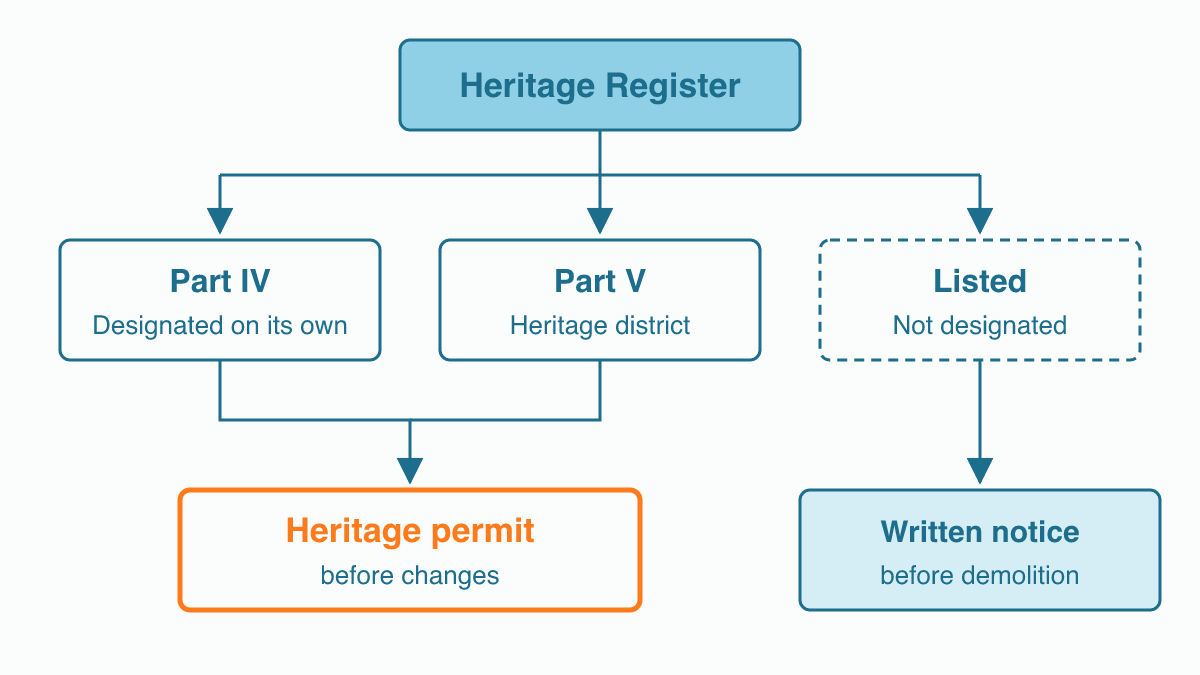
A property designated on its own has a by-law. The register page says these properties "have a by-law registered on title". The by-law "may include a list of heritage attributes, or features of the property that must be conserved". Listed properties have no such by-law.
To read yours, note the by-law number and year in the search tool. For a property designated before 1998, the page says to contact the City Archives at 416-392-5431. For one designated after 1998, it points to the City's By-law Status Registry.
What work needs a heritage permit on a designated property?
For a property designated on its own, the Heritage Permit Guide says "Permission is required for work that involves altering, demolishing/removing or erecting a building or structure".
- Altering means a change "likely to affect" one or more heritage attributes "as described in the designation by-law".
- Removing an attribute means "the complete removal of one or more of the attributes described in the designation by-law".
- Removing a building means taking down "any building or structure on the property", "whether or not" that would affect the heritage attributes.
The law draws the same line. Section 33 of the Ontario Heritage Act covers alterations "likely to affect the property's heritage attributes". For those, the owner needs the council's "consent in writing".
If you are not sure your work counts, ask Heritage Planning staff at heritageplanning@toronto.ca. The guide says applications "are submitted by email and permission must be obtained before starting work".
What work needs a heritage permit in a heritage district?
The City's Heritage Conservation Districts page lists each district. Cabbagetown, Riverdale, Rosedale and Harbord Village are on it, among others.
The page says "New construction, exterior alterations, and additions to properties within an HCD will require a heritage permit". The work must also "meet the policies of the relevant HCD Plan". That plan is the district's own rule book.
The page lists work that needs no heritage permit:
- An alteration or renovation "that is not visible from the street" or from other public areas
- "An alteration or renovation that only affects the interior of a building"
- "Routine maintenance activities"
The same page says "There is no cost to apply for a standalone heritage permit".
Each plan can add detail. The City says "An HCD Plan will also explain when a heritage permit is required for that specific district". The Act agrees. Section 42 allows "minor alterations or classes of alterations as are described in the heritage conservation district plan" without a permit.
How does a heritage permit fit with the building permit?
In a district, it runs through the building permit. The Heritage Permit Guide says to "submit your drawings, specifications and details through Toronto Building as part of your Building Permit application". Toronto Building is the City division that issues building permits. Heritage Planning then reviews the application "through this process". If the work needs no building permit, the guide says to contact Heritage Planning staff directly.
The district page is plain: "A heritage permit does not replace a building permit". When a project needs both, "the two permit systems are assessed and issued together". Our guide to building permits vs zoning approval covers the other approval many projects need.
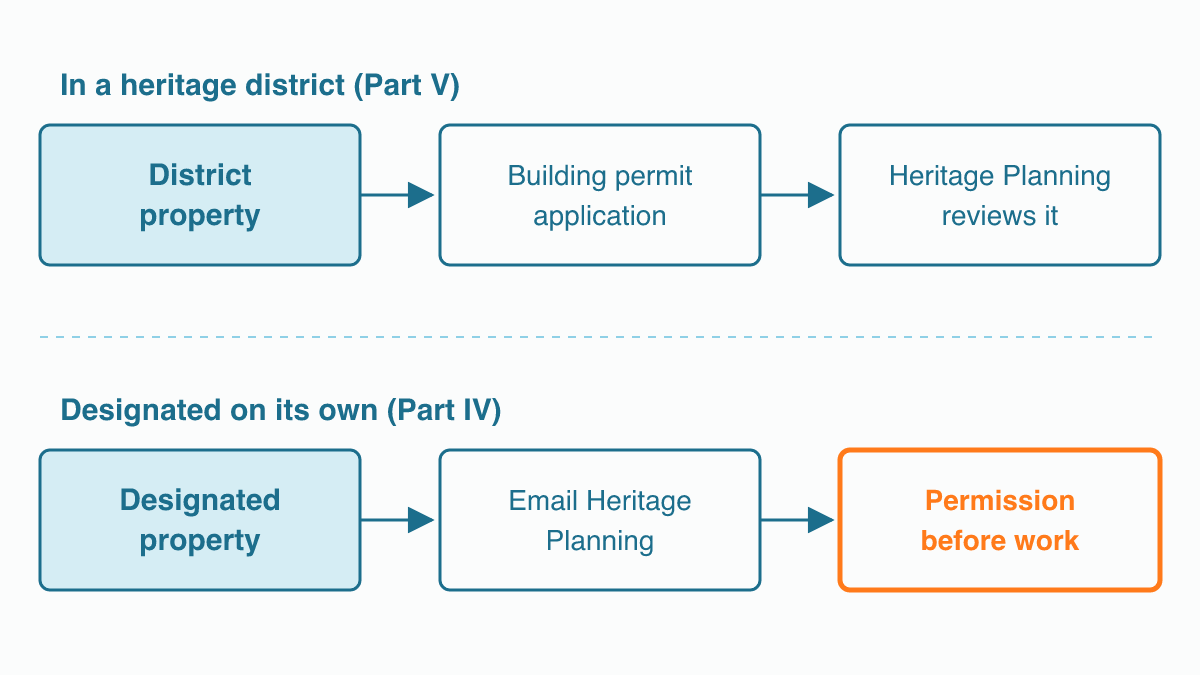
A property designated on its own uses a separate email request. The City's pages do not say whether to file it before or after the building permit. Ask Heritage Planning before you file either one.
Heritage status also matters for Toronto Building's fast stream, called Express Services. Its Express Building Permits page leaves out "Projects for properties requiring Heritage Approval". Our solar panel permit and roof replacement permit guides note where heritage comes up for those jobs.
How do you apply for a heritage permit?
For a property designated on its own, the Heritage Permit Guide starts with the "2021 Heritage Permit Application Form and Checklist". It also asks for:
- recent photos of the buildings and heritage attributes affected,
- a site plan or sketch showing where the work goes,
- drawings and specs of what is there now and what you plan,
- a description of the property and the reasons for the work,
- details of the potential impact on heritage attributes, and any heritage studies that apply.
The drawings use colour. Parts to be removed go in red on the existing drawings. On proposed drawings, retained parts are black and new work is blue. Our permit drawings guide covers the building permit side.
One study is a Heritage Impact Assessment. The application requirements page calls it "an independent professional and objective study". The guide asks for one if you plan "the demolition or removal of a building or structure". It also asks for one with some planning files, such as a minor variance. That is permission to depart slightly from a zoning rule.
You email the package to heritageplanning@toronto.ca. Meeting staff first is optional, but the guide says it "may simplify the application process". The City pages we read do not state a fee for a property designated on its own.
Who decides: City staff or City Council?
Some decisions sit with staff. The Heritage Permit Guide says Council has delegated authority to the Chief Planner and Executive Director. So "the decision to approve some Heritage Permits can be made by staff". The guide says delegated decisions "generally relate to" proposals that fit four sets of rules:
- the relevant district plan
- heritage guidelines adopted by Council
- heritage guidelines from the Ontario Minister of Culture and the Government of Canada
- the Parks Canada Standards and Guidelines
It then adds "and provided that", followed by four points:
- changes to the outside of the building and its features "are not visible from a public right-of way or public park"
- "The work is replacement where repair is not feasible and the replacement work utilizes the same types of materials as the original exterior heritage fabric"
- "The façade or building restorations is consistent with historic documentation" [sic]
- "The alterations address accessibility, life safety, mechanical and other applicable Building Code requirements"
Applications outside that authority go to City Council, in what the guide calls "a public process". The Toronto Preservation Board and Community Council weigh in first. The City calls the board "a municipal advisory committee to Council". Community Council is a committee of local councillors. The City has four, and "each represents an area of the city". Decisions can be appealed to the Ontario Land Tribunal. That tribunal hears land use planning and "heritage protection" cases, among others.
On timing, the guide says the Act requires a decision "within 90 days" of the Notice of Complete Application. That is the City's notice that your file is complete. If you did not agree to extend that period and Council has not decided, "the permit is deemed approved". The catch: without an extension, revised material "is unlikely to be considered". For a property in a district, the district page says "Most heritage permit applications can be approved within a week". Complicated ones can take longer.
What does "listed" mean if you plan to demolish?
The Heritage Register page says listed properties "do not have any protection under the Ontario Heritage Act". The one exception is notice. An owner "must give the council at least 60 days' notice of their intention to demolish or remove a structure on the property". That gives the City time to decide whether to designate it.
The application requirements page says the notice must be written. Its contents "are prescribed in Chapter 103-7.2" of the Toronto Municipal Code. Our demolition permit guide covers the building permit side of a demolition.
Listing does not stop renovation. The register page says it "does not preclude a property from undergoing renovation or development".
Listing can also end. The application requirements page says "properties that were listed prior to January 1, 2023, may only remain listed until January 1, 2027". Listed properties not designated by then "will be removed from the Heritage Register".
Where should you start?
Check the address in the search tool, then read your by-law or district plan.
PermitIndex's permit search, which requires signing in, is our own product. It is built from the City's open data on active building permits. It shows building permits, not heritage status.
Methodology and limits
This guide has no permit statistics by design. We read seven City of Toronto pages, one Ontario Land Tribunal page and the Ontario Heritage Act on October 14, 2026. The pages and their "date modified" are: Heritage Permit Guide, April 13, 2026; Application Requirements for Heritage Properties, April 26, 2026; Heritage Register, February 27, 2026; Heritage Conservation Districts and Studies, October 9, 2026; Express Building Permits, December 19, 2025; Toronto Building, January 29, 2026; About Your Local Government, January 24, 2025; About the OLT, February 22, 2024. The e-Laws page for the Act needs JavaScript, so we read the Word copy e-Laws offers at ontario.ca/laws/docs/90o18_e.doc. Each source is linked where the article uses it.
Limits: we did not read Chapter 103 of the Municipal Code or any district plan. Other Ontario municipalities set their own rules; check with yours. The City's pages win where they differ from this one. The permit search above is PermitIndex's own product. What its data covers, and our contact email, are on the data sources page.
Frequently asked questions
- How do I find out if my Toronto house is a heritage property?
- Use the City's Heritage Register map or its Heritage Property Search tool. The City calls the search tool the most up-to-date way of confirming whether a property is on the Heritage Register.
- Does a listed heritage property in Toronto need a heritage permit?
- No. The City says permits are not required for properties on the Heritage Register that are listed but not designated. Listing still matters if you plan to tear something down. The owner must give the City written notice before removing or demolishing a building or structure, so the City has time to decide whether to designate it.
- Does a heritage permit replace a building permit?
- No. The City's Heritage Conservation District page says a heritage permit does not replace a building permit. If your project also needs a building permit, the City says the two permit systems are assessed and issued together. In a district, Heritage Planning reviews your drawings inside the building permit application at Toronto Building, the City division that issues building permits.
- Can I renovate the inside of a house in a heritage district without a heritage permit?
- Yes, if the work only affects the interior. The City says a heritage permit is not required for an alteration or renovation that only affects the interior of a building in a Heritage Conservation District. A house designated on its own can differ. The City's guide refers to interior heritage attributes described in a designation by-law, so read your property's by-law first.
- Who approves a heritage permit in Toronto?
- It depends on the proposal. City Council has delegated some decisions to the Chief Planner and Executive Director, so staff can approve them. Other applications go to City Council for a final decision, after the Toronto Preservation Board and Community Council make recommendations. The City says decisions can be appealed to the Ontario Land Tribunal, which hears land use and heritage disputes.