Toronto permit data
Do Building Permits Expire in Ontario?
Published September 9, 2026
The short version
- A building permit in Ontario has no expiry date. Once issued it authorizes the work until the permit is closed or revoked.
- What ends a permit early is revocation. Toronto Building's own report to Council states the chief building official may revoke a permit when construction has not seriously commenced within six months of issuance, or has been substantially suspended or discontinued for more than a year.
- Toronto treats a permit with no inspection activity as dormant and issues a Notice of Intention to Revoke before acting.
- A revoked permit cannot be revived. Restarting means a fresh application and fresh fees, per the City's closing building permits page.
- Finishing the work is not the end either. A permit stays open until the final inspection passes and the City closes it.
Do building permits expire in Ontario?
Short answer: No. An Ontario building permit does not come with an expiry date. Toronto Building put it plainly in a 2021 report to City Council: once issued, a permit authorizes the construction proposed and does not have an expiry date. What can end a permit is revocation by the chief building official, and the same report names the two usual triggers as construction that has not seriously commenced within six months of issuance, or construction substantially suspended or discontinued for more than a year.
That distinction matters more than it sounds. People search for an expiry date because they want to know how long they have. The honest answer is that the clock which actually runs against you is not a validity period. It is the City watching whether anything is happening on your site.
What actually ends a building permit?
A permit leaves the system in one of two ways, and only one of them is good news.
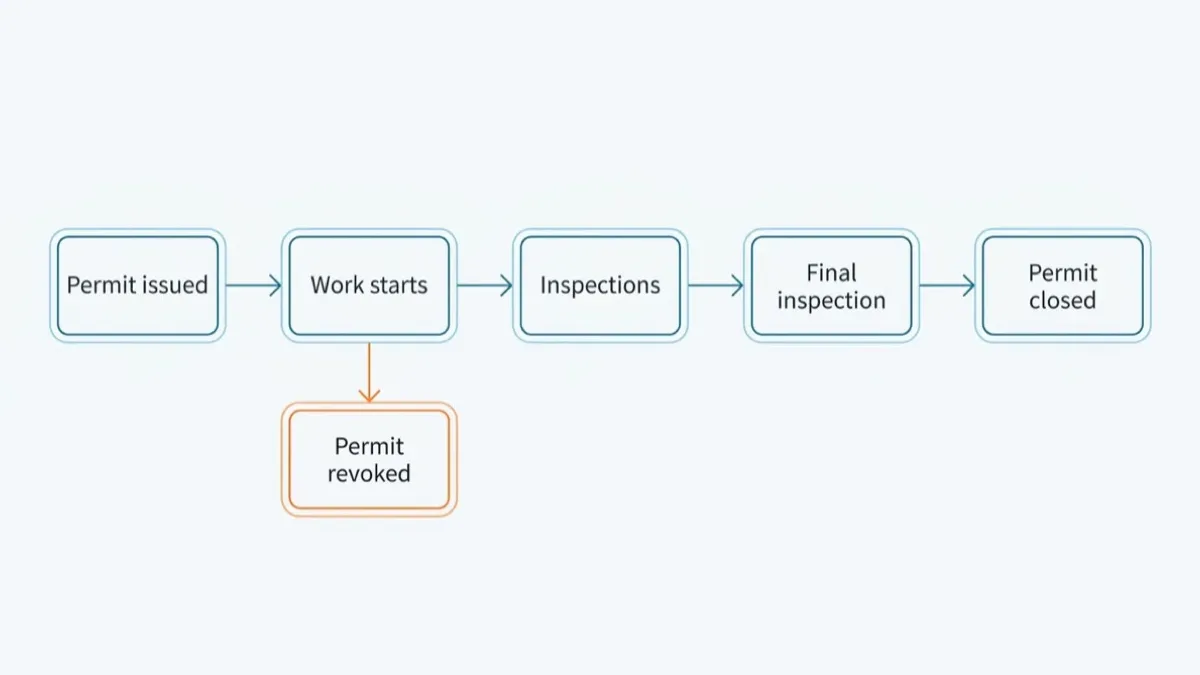
Closed. You finish the work, the required inspections pass, the City records a final inspection, and the permit is closed against the address. Toronto's closing building permits page states the rule directly: a permit remains open until all required inspections are completed and the permit is officially closed.
Revoked. The work stalls or never starts, the City notices, and the chief building official pulls the permit. That is the path this article is really about, because it is the one that surprises people.
Notice what is missing from that list. There is no third option where the permit simply lapses on its own and the file quietly closes itself. An unfinished job does not tidy itself up. It sits open against the property until somebody acts.
When can the chief building official revoke a permit?
The revocation power lives in the Building Code Act, and Toronto Building summarized how it uses that power in its 2021 report. Two situations do most of the work:
- Construction has not seriously commenced within six months of issuance. You pulled the permit and then nothing happened on site.
- Construction has been substantially suspended or discontinued for more than a year, in the opinion of the chief building official. You started, then stopped, and the site went quiet.
The same report is candid about the limits of that power. The Act does not let the chief building official attach conditions to a permit that would compel the holder to finish construction within a set time, and the City cannot set an expiry date on a permit. Council asked whether it could. The answer that came back was no, and the report added that even with that authority the City could not force construction to continue, because the root cause of a stalled site is usually money rather than paperwork.
Quotable: Ontario does not expire building permits. It revokes them, and only after the site has been visibly idle.
Revocation is also discretionary rather than automatic. Toronto uses Municipal Code Chapter 363 to run the process fairly: notice of a pending revocation goes to the permit holder, and the holder gets an opportunity to respond before the chief building official decides. It is not a trapdoor.
How does Toronto handle a dormant permit?
This is where the City publishes something concrete you can plan around. Toronto's closing building permits page defines a dormant permit as one that has had no inspection for eighteen months or more, and says a Notice of Intention to Revoke is issued when a building permit is more than eighteen months old and no inspections have been requested.
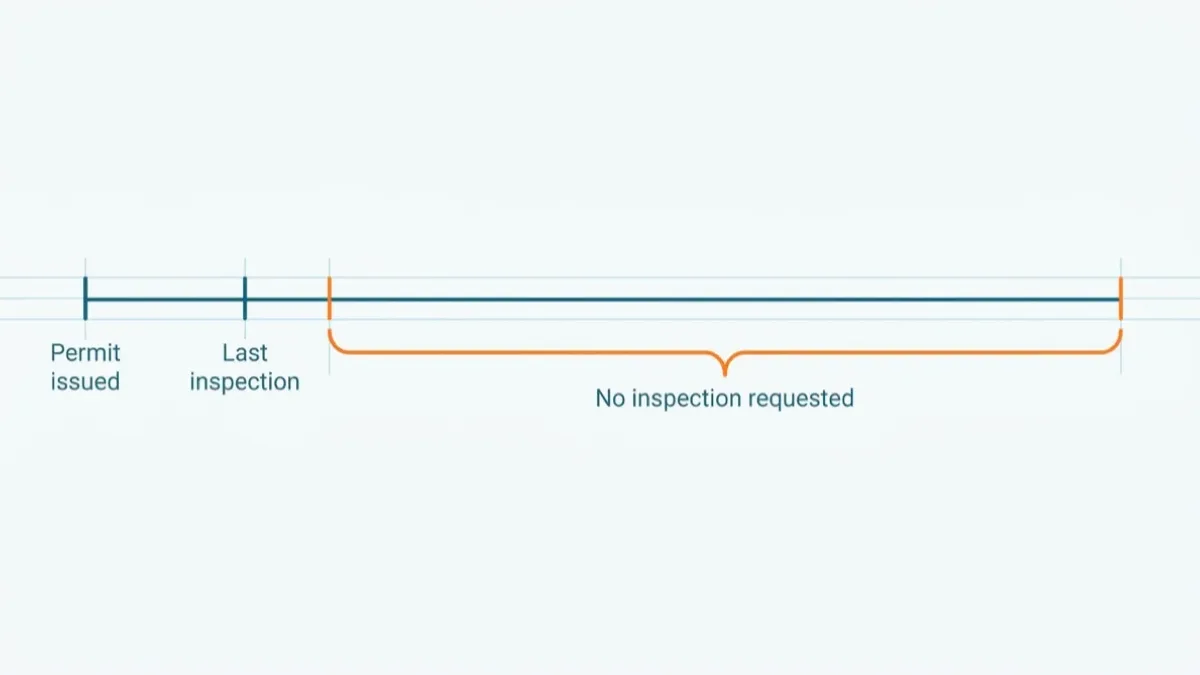
The notice sets a date. To avoid revocation you must request an inspection before that deadline and demonstrate that construction or demolition has genuinely started. The City is blunt about the failure modes: if you do not request an inspection, or if an inspection shows that work has not actually begun, the permit will be revoked.
Two practical readings follow from that. First, inspection activity is the signal, so a project that is genuinely moving generates its own evidence and never gets near the notice. Second, a permit pulled early to lock in a review and then parked while financing comes together is exactly the file this process is built to catch.
The volumes are not trivial either. Toronto Building told Council that between the start of 2017 and the spring of 2021 the division revoked roughly a thousand permits, and that more than half of those were small residential construction where work had never commenced.
What happens after a permit is revoked?
You lose the authorization and you do not get it back. The City's guidance is that if a permit is revoked and you want to start or resume construction, you have to reapply for a new building permit and pay the required application fees. The second application is a fresh review under whatever rules are current at that point, not a resumption of the old file.
What does not disappear is the construction. The 2021 report notes that on revocation there is no corresponding authority for the City or the chief building official to remove or finish work already carried out while the permit was in force. A half-finished structure with a revoked permit is a problem the City handles through site safety, property standards, and pressure on the owner, not by undoing the build. If you are looking at unpermitted or half-permitted work on a property you own or are buying, the consequences are covered in more depth in building without a permit in Ontario.
How do you close a permit properly?
Closing is the step most homeowners forget, because from the kitchen the job looks done. The City requires a final inspection to verify the completed work complies with the Ontario Building Code, and until that inspection is recorded the permit stays open. Book the inspections as each stage is ready rather than saving them all for the end, since a stage that has been covered up may have to be opened again. The full sequence is set out in our guide to Toronto building permit inspections.
If you are not sure what is outstanding on your own address, or you are checking a property before you buy it, search the permit record by address and see what is on file. An issued permit with no closing activity behind it is worth a question to the seller or to Toronto Building. For how long the approval side of the process takes in the first place, see how long a Toronto building permit takes, and if your project is a landscaping job rather than a building one, retaining wall permits in Toronto covers the threshold that catches people there.
Methodology and limits
How these numbers are calculated
This guide carries no permit statistics by design. Every rule in it is taken from a named public source and linked at the point of the claim: Toronto Building's June 2021 report Expiry Dates for Building Permits to the Planning and Housing Committee, the City of Toronto closing building permits page, and Toronto Municipal Code Chapter 363. Those sources were read on 2026-09-09. Where the City states a threshold in months, the wording above follows the City's own wording rather than paraphrasing it into a different number.
Two limits apply. Revocation is a discretionary power exercised by a chief building official, so practice varies between municipalities even though the enabling statute is province wide, and the specific dormancy thresholds quoted here are Toronto's. Regulations and municipal procedures also change, and this page will not update itself the moment one does, so confirm anything decision critical with Toronto Building or your own municipality. For the permit dataset behind the rest of this site, see the data sources page.
Frequently asked questions
- How long is a building permit good for in Ontario?
- There is no fixed term. The Building Code Act does not give a permit an end date, and Toronto Building has told City Council that the City has no authority to set one. A permit stays in force until it is closed after the final inspection, or until the chief building official revokes it. In practice that means the answer to how long yours lasts depends on whether you keep the work moving, not on a date printed anywhere.
- Can the City cancel my building permit?
- Yes. The chief building official has the power to revoke a permit, and Toronto Building's report to Council describes the main triggers as construction that has not seriously commenced within six months of issuance, or construction that has been substantially suspended or discontinued for more than a year. Toronto Municipal Code Chapter 363 sets out a notice process, so you get warning and a chance to respond before a revocation lands.
- What is a dormant building permit?
- The City's own term for a permit that has gone quiet. Toronto's closing building permits page says a permit with no inspection for eighteen months or more is considered dormant, and that a Notice of Intention to Revoke is issued when a permit is more than eighteen months old and no inspections have been requested. Dormant is a status, not a penalty, but it is the step before revocation.
- How do I stop my permit from being revoked?
- Request an inspection before the deadline in the notice and be able to show an inspector that construction has genuinely started. The City is explicit that if no inspection is requested, or an inspection shows the work has not actually begun, the permit will be revoked. Booking an inspection you are not ready for does not help, because the inspector has to see real work.
- Can a revoked building permit be reinstated?
- No. The City's guidance is that if your permit is revoked and you want to start or resume construction, you have to reapply for a new building permit and pay the required application fees again. Anything already built under the old permit stays where it is, which is one reason a stalled site is a difficult problem for a municipality to solve.
- Does an open permit cause problems when selling the house?
- It can. An open permit means the City never recorded a passed final inspection for that work, and it stays visible against the address. Buyers, their lawyers, and home inspectors do look, and an open permit on a renovation is the kind of item that turns into a holdback or a price adjustment late in a deal. Closing a permit is much easier while the trades are still on site.