Toronto permit data
Change of Use Permits in Toronto
Published October 15, 2026
The short version
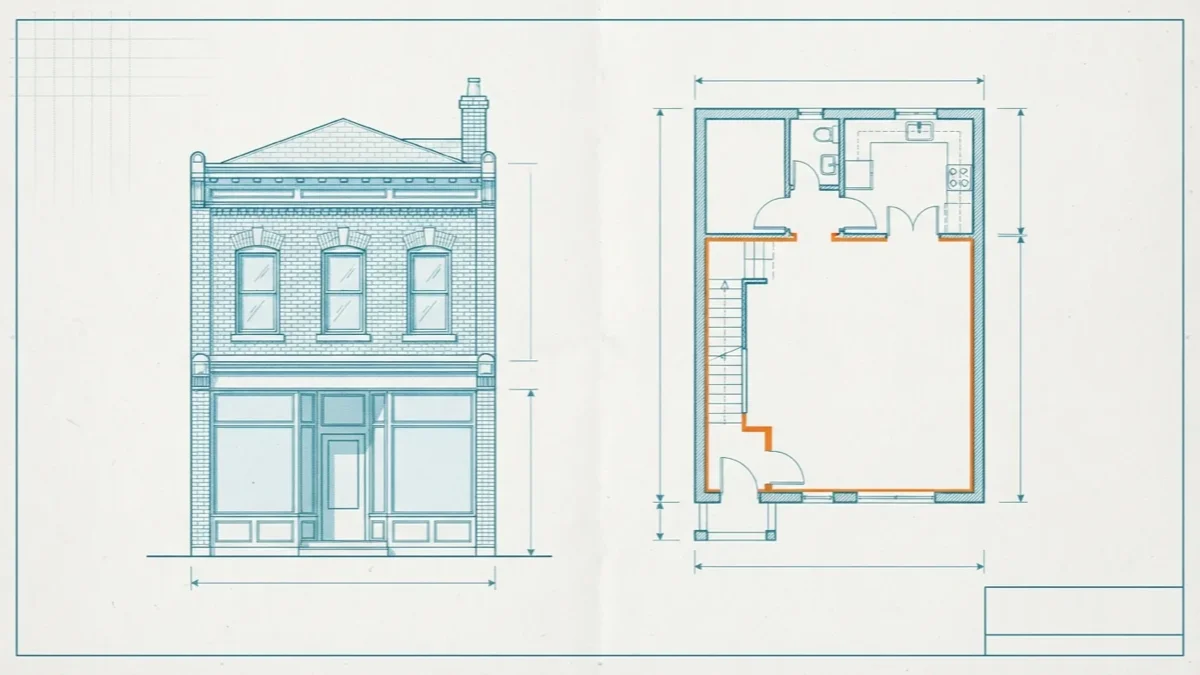
- A change of use permit is a building permit for changing what a building, or part of it, is used for. In Toronto it can be needed even when no construction is planned.
- The City's own examples are a change from residential to office, or from a single dwelling unit house to a multi-dwelling unit house.
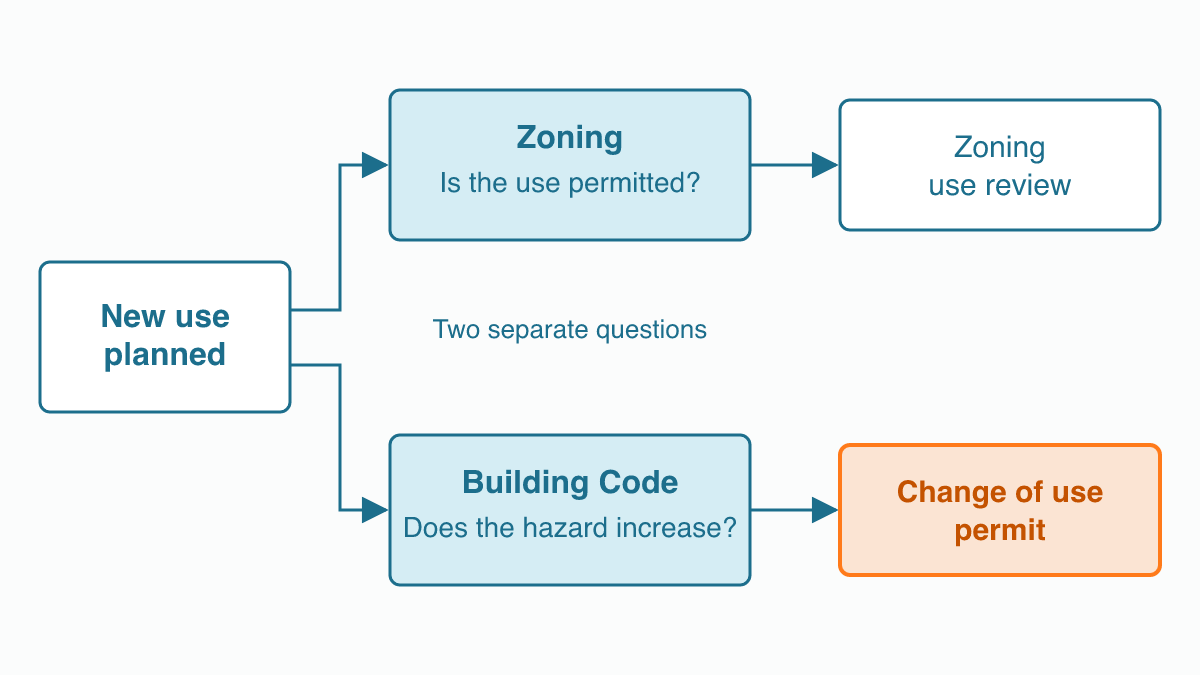
- Ontario's Building Code Act requires the permit when the new use would cause an increase in hazard, meaning a higher safety risk, as the Building Code decides.
- Zoning, the City's rules on which uses are permitted where, is a separate check. For listed uses, Toronto offers a use-only zoning review that needs no plans.
Do you need a permit to change a building's use in Toronto?
Short answer: Often, yes, even when nothing gets built. The City's When Do I Need a Building Permit? page lists "Change a building's use" among projects that need a permit. Its examples are "from residential to office or single dwelling unit house to multi-dwelling unit house." On construction it is explicit: "Even if no construction is proposed, if a change of use is proposed a building permit is required." Zoning is a separate check.
A change of use permit is a building permit for a new use rather than new work. It is issued by the chief building official, the City official in charge of building permits.
For a basement unit or second unit in a house, see our guides to legal basement apartments and second suites.
What does Ontario law count as a change of use?
The rule is section 10 of Ontario's Building Code Act, 1992, the provincial law behind building permits. Subsection 10(1) opens: "Even though no construction is proposed." It bars anyone from changing, or letting someone change, "the use of a building or part of a building." The bar applies if "the change would result in an increase in hazard, as determined in accordance with the building code." The exception is where "a permit has been issued by the chief building official."
Two phrases matter. "Part of a building" means the rule can cover a single part as well as the whole building. "Increase in hazard" means a higher safety risk from the new use. The Act leaves that test to the Building Code. Section 34 lets the Minister make regulations "determining an increase in hazard for the purposes of section 10."
The Building Code itself sets the test for which changes raise the hazard. The current code is the 2024 Building Code, Ontario Regulation 163/24. This guide does not reproduce that test. To find out whether your change raises the hazard, ask Toronto Building. The City's When Do I Need a Building Permit? page names it as the contact for questions.
Why does the City's page sound stricter than the Act?
The City's general permit page says a permit is required "if a change of use is proposed," with no mention of hazard. The Act ties the permit to a change that "would result in an increase in hazard."
The City's guide for multi-tenant houses, which it says are "also known as rooming houses," uses the Act's test. A permit is required "if the change would result in an increase in hazard as determined in accordance with the Ontario Building Code." Its example is "changing the use of a building from a house with a single dwelling unit to a house with multiple dwelling units."
Do not assume your change falls under the hazard line. Neither page gives a list of changes that are safe to make without a permit.
When must the City issue the permit?
The Act limits the grounds for saying no. Subsection 10(2) says the chief building official "shall issue a permit under subsection (1), unless" any one of these applies:
- "the building if used as proposed would result in a contravention of this Act or the building code or any other applicable law"
- "the application for it is incomplete"
- "any fees due are unpaid"
"Applicable law" means other laws, listed in the Building Code, that a use or project must also meet. Section 8 of the Building Code Act refers to "such other applicable law as may be set out in the building code." Chapter 363 of the Toronto Municipal Code defines a Zoning Applicable Law Certificate as one issued "after a detailed preliminary review of a proposal." By that definition, the certificate confirms the proposal's "compliance with zoning and all applicable law related to the proposal."
What goes into a change of use application?
Chapter 363, titled Building Construction and Demolition, is Toronto's by-law on building permits. Section 363-3.8 says a change of use application "shall" do four things. In these rules, "occupancy" is the use a space is put to.
- "Meet the requirements of § 363-3.3B or C as applicable."
- "Describe the building or part of it in which the occupancy is to be changed."
- "Include plans and specifications which show the current and proposed occupancy of all parts of the building." They must also "include sufficient information to establish compliance with the requirements of the Building Code." That includes, "but not limited to," floor plans and "details of wall, floor and roof assemblies identifying required fire-resistance ratings and load-bearing capacities."
- Include "any other information which may be required by the Chief Building Official."
A fire-resistance rating is how long a wall or floor is rated to hold back fire. Load-bearing capacity is how much weight it can carry.
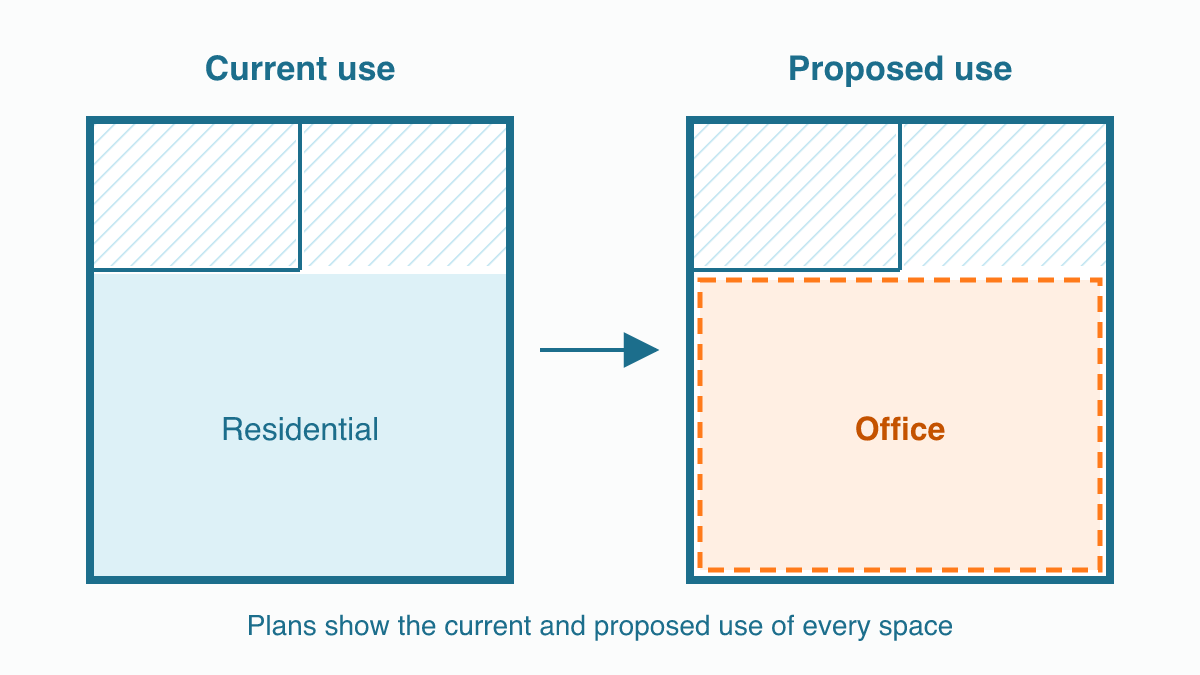
The City's Interior Alterations (Non-Residential) guide covers interior work "where the floor area of the building does not increase." It notes that "The use of the building may also change." Its list of drawings includes "Dimensioned floor plans for each level, showing existing and proposed uses of all spaces."
The City's permit application form has two boxes for this. One is "Proposed use of building" and the other is "Current use of building."
On cost, the City's building permit fees page lists "Permit for Change of Use" at a minimum fee of $297.41 per permit, plus $92.79 for each additional hour. Those are the rates as published, effective January 1, 2026.
Is zoning approval a separate step?
Yes. Zoning is the City's by-law on what can be built and which uses are permitted at each location. The City's zoning appointment page says: "You may need zoning approval and a building permit when changing the use of a building, even if no construction is involved." Our guide to the Toronto building permit office covers how to book that appointment.
For a use-only answer, the City offers a Zoning Use Review. Chapter 363 defines it as "A one-time review to determine whether a proposed use is permitted under the City's zoning by-laws." Applying needs no drawings: "No plans are required to make an application." The review covers 11 uses, from "Animal Care" and "Child Care" to "Restaurant" and "Office."
The review is narrow. According to the Zoning Use Review page, it "will not include parking, loading, built form standards, or any other qualifications or conditions related to that use." A full Zoning Applicable Law Certificate review is required instead for recycling uses, transfer stations, drive-thrus, patios "and any use not indicated on the application form." The fee is $214.79 per request, non-refundable, as published, effective January 1, 2026.
Our guides to checking a property's zoning and to building permits versus zoning approval go further on the zoning side.
What if the new use needs a business licence?
Some uses need a zoning sign-off as part of the licence application. The City's Zoning Review for Business Licence page names uses that "require written confirmation to show that a proposal complies with the Zoning By-law." They include "public garages," "eating or drinking establishments," "adult entertainment establishments" and "commercial parking lots."
That page carries a warning: "If any building alterations are proposed, or if a new major occupancy is being introduced into the building, a building permit may be required." A major occupancy is one of the Building Code's use classes, which Chapter 363 calls "the major occupancy classifications in the Building Code." The City's Express Services page labels Group A & F as "Assembly and Industrial." It files "Business, Office, Retail Uses and Restaurants with less than 30 seats" under "Group D & E Occupancies."
Where a permit will be needed, the licence page advises that "it is recommended to apply for a Zoning and Applicable Law Certificate instead."
Can a change of use go through Express Services?
Express Services is the City's stream for "smaller, less complex projects within a predefined scope." Its two interior alteration categories for Group A & F and Group D & E occupancies each list "No change in use" among their conditions.
The same page also lists "1 to 2 unit conversions (no more than 2 unit dwellings per building)" among its projects. Whether your conversion fits that scope is for Toronto Building to confirm.
What if you change the use without a permit?
The City puts the duty on the owner. Its When Do I Need a Building Permit? page says: "As the building owner, you are ultimately responsible for complying with all building requirements." It warns that failing to get permits "can result in costly construction delays, legal action and/or the removal of work already completed." Section 36 of the Building Code Act makes it an offence when a person "contravenes this Act." That includes changing a use without a permit that section 10 requires. Our guide to building without a permit in Ontario covers what happens next.
How do you check a property before you lease or buy?
PermitIndex's permit search, which requires signing in, is our own product. It is built from the City's open data on active building permits. It can show active building permits on file at an address. It cannot tell you what use zoning permits there.
For the zoning designation, the City's Preliminary Zoning Reviews & Information page offers a Property Information Report. It lists "Details on active building permits, violations, work orders and the zoning designation that may apply to a property."
Methodology and limits
This guide carries no permit statistics by design. We read every source on October 14, 2026, except the 2024 Building Code regulation, read October 15, 2026. They include the Building Code Act, 1992 (e-Laws Word version, consolidated from June 2, 2026) and Chapter 363 of the Toronto Municipal Code (stamped March 22, 2024). The permit application form is effective February 16, 2026. The City pages show these modified dates: When Do I Need a Building Permit? (July 21, 2026), the multi-tenant houses guide (March 13, 2025) and Interior Alterations (Non-Residential) (February 13, 2026). The others are fees (June 19, 2026), Zoning Use Review (January 6, 2026), Zoning Review for Business Licence (February 20, 2026) and Express Services (December 19, 2025). Two zoning pages show no date. Each source is linked where first used.
Four limits apply. We did not review the code text that the 2024 Building Code (O. Reg. 163/24) adopts, so this guide does not say which changes count as an increase in hazard. These are Toronto's rules. Other Ontario municipalities set their own rules, so check with yours. The City's pages are authoritative where they differ from this one. And the permit search linked above is PermitIndex's own product, built from the City's open building permit data. What that data covers, and the site's contact email, are on the data sources page.
Frequently asked questions
- What is a change of use permit?
- It is a building permit for changing how a building, or part of it, is used, even when nothing is built. Section 10 of Ontario's Building Code Act requires one when the new use would cause an increase in hazard, which is a higher safety risk under the Building Code. The permit is issued by the chief building official, the City official in charge of building permits.
- Do you need a permit to change the use of a building in Toronto with no construction?
- Often, yes: the City's When Do I Need a Building Permit? page says that even if no construction is proposed, a building permit is required if a change of use is proposed. Its examples are residential to office, and a single dwelling unit house to a multi-dwelling unit house. The provincial Act ties the permit to an increase in hazard, so ask Toronto Building about your case.
- Is a change of use permit the same as zoning approval?
- No. The permit deals with the Building Code, and zoning, the City's rules on which uses are permitted at each location, must also be met. The City's zoning appointment page says you may need zoning approval and a building permit when changing the use of a building. A Zoning Use Review answers the zoning question for some uses without plans.
- What do you file for a change of use permit in Toronto?
- Section 363-3.8 of the Toronto Municipal Code says the application must describe the part of the building where the use is changing. It must include plans showing the current and proposed use of all parts of the building, with enough detail to show Building Code compliance. The chief building official may ask for more information.
- Can the City refuse a change of use permit?
- Under subsection 10(2) of the Building Code Act, the chief building official must issue the permit unless one of three things applies. Those are that the new use would break the Act, the Building Code or any other applicable law (other laws, listed in the Building Code, that a use or project must also meet), that the application is incomplete or that fees due are unpaid. Outside those cases, the Act says the official shall issue it.