Toronto permit data
Do You Need a Permit for a Bathroom or Kitchen Reno in Ontario?
Published July 24, 2026
The short version
- Cosmetic bathroom and kitchen updates, such as painting, new cabinets, counters, and swapping fixtures in the same spot, generally do not need a building permit in Ontario.
- A permit generally comes into play once the renovation adds or relocates plumbing, removes or adds walls, or changes anything structural.
- Electrical work is a separate track: it goes through the Electrical Safety Authority, not the municipal building permit office.
- Permits are administered by your municipality, so confirm your specific project with your local building department before work starts.
Do you need a permit for a bathroom or kitchen reno in Ontario?
Short answer: Usually not for cosmetic work. Painting, cabinets, counters, flooring, and replacing fixtures in the same location generally do not need a building permit in Ontario. A permit generally applies once the renovation adds or moves plumbing, removes or adds walls, or alters structure. Confirm your project with your municipality; in Toronto that is Toronto Building.
The legal line comes from Ontario's Building Code Act, which requires a permit for the construction, demolition, or material alteration of a building. A bathroom or kitchen reno sits right on that line: the same room can be a permit-free refresh or a permit-required alteration depending on what you touch. The rest of this guide walks the line item by item, then shows what these jobs look like in Toronto's actual permit record.
What bathroom and kitchen work does not need a permit?
The permit-free zone is finishes and like-for-like replacement. The City of Toronto's published examples of work that does not require a building permit include installing cabinetry and millwork, and repairing or replacing plumbing fixtures. Most Ontario municipalities draw the line in a similar place, though the wording varies, so treat the City's list as the Toronto version rather than a provincial rule.
In practice, that generally covers:
- Painting, wallpaper, and drywall repairs that do not alter walls.
- New flooring or wall tile.
- Replacing kitchen cabinets, counters, or a bathroom vanity.
- Swapping a toilet, sink, tub, or shower for a new one in the same location, connected to the existing drains and supply lines.
- Replacing appliances that use existing connections.
The common thread is that nothing about the building changes: no wall moves, no new opening appears, and the plumbing system itself is untouched even though the fixtures hanging off it are new. Keep the scope inside that boundary and the renovation is generally yours to run without an application. Step outside it anywhere, and the whole project usually needs a permit, not just the offending piece.
What bathroom and kitchen work does need a permit?
A permit is generally required the moment the renovation becomes a material alteration. For bathrooms and kitchens, the triggers that show up most often are:
- Adding or removing walls. Toronto's guidance names adding or removing walls, meaning changes to room sizes or uses, as permit work. That includes opening a kitchen to the living room, and it is not limited to load-bearing walls.
- Installing or modifying plumbing systems. Moving a sink to a new wall, adding a second bathroom, relocating a drain stack, or roughing in plumbing for an island all fall here.
- New windows or doors where there were none before. Cutting a new opening for a window over the sink is structural work; replacing a window in its existing opening generally is not.
- Structural changes of any kind. Removing a load-bearing wall, cutting joists for a new drain run, or reinforcing a floor for a heavy tub.
- Adding a bathroom where none existed, which combines new plumbing with changed room use.
These are the Toronto formulations, published on the City's when do I need a building permit page. Other Ontario municipalities apply the same Building Code Act test with their own wording. When any item on your scope sheet resembles the list above, ask the building department before demolition starts, not after.
Does moving a sink, toilet, or shower trigger a permit?
Generally yes, and this is the distinction that catches the most homeowners. Replacing a fixture is exempt; relocating one is not. The difference is whether the plumbing system changes. A new toilet bolted onto the existing flange uses the system as built. Shifting that toilet even a short distance means cutting into drains and vents, and modifying a plumbing system is on Toronto's list of work that requires a permit.
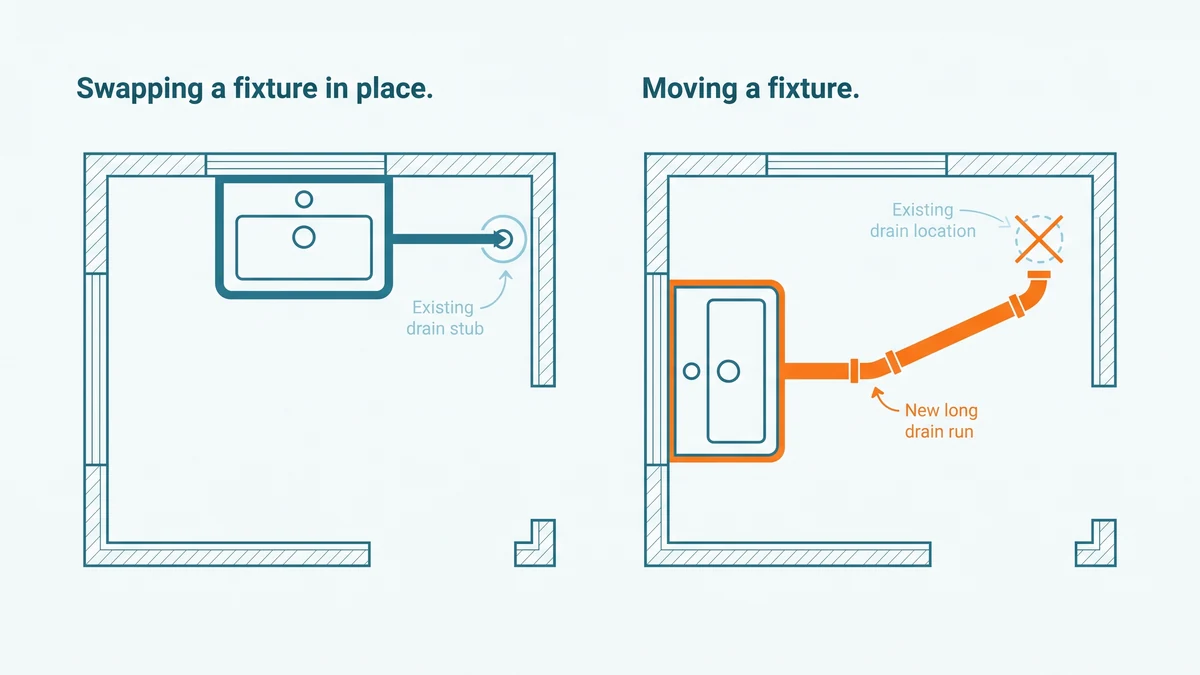
This is why a gut renovation with a new layout almost always needs a permit while a same-layout refresh usually does not, even when the two projects cost similar amounts and look equally dramatic mid-demolition. The permit question follows the pipes and the walls, not the price tag or the mess. If your designer's floor plan shows any fixture in a new position, plan on a permit application and factor the review time into the schedule. Our guide to what requires a building permit in Ontario covers the same test applied across every other project type, and the pattern holds: systems and structure trigger permits, surfaces do not.
What about electrical work in a kitchen or bathroom?
Electrical runs on a separate track in Ontario, and it is not covered by the building permit. Wiring work, new circuits for appliances, and panel changes are overseen by the Electrical Safety Authority, which generally requires a notification of work to be filed when electrical work is done, whoever does it. A licensed electrical contractor files it for work they perform; a homeowner doing their own wiring in their own home must file it themselves.
So a kitchen reno can need a building permit, an ESA notification, both, or neither, depending on scope. New pot lights on existing circuits with no wall changes may need only the ESA filing. A layout change with new appliance circuits typically needs both. Neither filing substitutes for the other, and a building inspector will not sign off on electrical, nor the reverse. The same split applies to mechanical work: if the reno extends to heating equipment, see our guide to furnace and AC replacement permits in Ontario for how that is handled.
What do bathroom and kitchen renos look like in Toronto's permit data?
Permitted bathroom and kitchen renovations rarely appear under those names in the public record. In the trade classification PermitIndex derives from the City's data, they mostly surface as interior alteration or plumbing permits, and those sit among the largest trade categories among Toronto permits currently on record. That is worth knowing because neither category has a dedicated public reference page anywhere, so the renovation activity they represent is easy to underestimate.
For scale: PermitIndex holds 30,995 Toronto building permits issued in the trailing twelve months as of Oct 9, 2026, drawn from the City's open data. The table below shows the observed gap between application and issuance by trade over the same window, Toronto only, among permits currently on record. It is an observed lag, not a City service commitment.
| Trade | Permits (12mo) | Median wait | 90th percentile |
|---|---|---|---|
| Window / Door | 905 | 11 days | 61 days |
| Deck | 1,533 | 21 days | 119 days |
| Interior alteration | 4,540 | 24 days | 91 days |
| Roofing | 540 | 25 days | 123 days |
| Plumbing | 6,685 | 27 days | 232 days |
| Pool | 173 | 31 days | 141 days |
| Addition | 5,021 | 32 days | 166 days |
| Electrical | 95 | 32 days | 92 days |
| HVAC | 4,654 | 34 days | 192 days |
| Demolition | 1,640 | 43 days | 229 days |
| New build | 2,945 | 58 days | 520 days |
Groups with fewer than 30 permits are omitted; a median over a smaller sample is noise.
Quotable: In Toronto's permit record, a renovation's wait is driven far more by what the project is than by where it sits. Simple like-for-like trades cluster at the fast end of the table while structural work sits at the slow end, a gap the data shows cross-sectionally within a single twelve-month window.
Read the interior alteration row as the closest proxy for a permitted kitchen or bathroom remodel, and the plumbing row for jobs filed primarily as plumbing work. The Toronto permit wait times page keeps the full breakdown, updated as the City's record refreshes.
How do you check the permit record for an address?
Two situations make the permit record worth a look: before your own reno, to see what has already been permitted at the property, and before buying a renovated house, to see whether the gleaming kitchen in the listing photos has a permit behind it.
You can search any Toronto address on PermitIndex and see the permits the City currently holds for it, free and without an account. An empty result is not proof that old work was unpermitted, because the City's dataset covers active permits and records leave it as projects close out. But for recent work the record is a strong signal, and a renovation that should have a permit and shows none is a question to raise before closing, not after. If the answer turns out badly, the consequences and the path to legalizing are covered in our guide to building without a permit in Ontario. For basement-level bathroom projects, which stack extra requirements on top of everything here, see the basement renovation permit guide.
How these numbers are calculated
The permit count on this page is the number of building permits issued in the City of Toronto in the trailing twelve months, computed live by the seo_citywide_12mo query against the City's open dataset of active building permits, and stamped with the newest issue date in that data. The wait table is computed by seo_wait_by_trade, which takes the median and 90th percentile of days between application date and issue date per trade over the same trailing twelve months, drops records where the issue date precedes the application date, and reports no figure for any trade with fewer than thirty permits. The trade labels are PermitIndex's own classification of the City's permit descriptions; the catch-all bucket for unmatched records is excluded because it is not a real category.
One limitation applies to every number here: the City publishes currently active permits, and records leave the dataset as projects close out. These figures describe permits presently on record in Toronto, not a complete historical census, and the waits are observed issuance lags, not a City processing commitment. Statements about what does or does not require a permit are general guidance, not a ruling on your project; that call belongs to your municipal building department. For the underlying dataset and its licence, see the data sources page.
Frequently asked questions
- Do I need a permit to retile my bathroom or replace the vanity?
- Generally no. Retiling, painting, new flooring, and replacing a vanity, toilet, or tub in the same location are treated as cosmetic work in most Ontario municipalities. The picture changes if the job also moves drains or supply lines, or opens up walls in a way that alters structure, so confirm the full scope with your municipal building department.
- Does a kitchen island or new cabinets require a building permit?
- Cabinet and millwork installation is generally exempt from a building permit. An island becomes a different question once it includes a sink or dishwasher, because running new drain and supply lines is plumbing work that municipalities typically require a permit for. Describe the full scope to your building department before committing to a layout.
- Do condo bathroom or kitchen renovations need a building permit?
- The Building Code applies to condo units the same way it applies to houses, so work that would need a permit in a house generally needs one in a condo too. On top of that, most condo corporations require their own alteration agreement before any renovation starts. Clear both the corporation and the municipality rather than assuming one covers the other.
- Who is responsible for getting the permit, me or my contractor?
- Either the owner or an authorized agent such as the contractor or designer can apply, but the legal responsibility for having a permit rests with the property owner. If a contractor says the job does not need one, verify that claim with your municipal building department yourself before relying on it.
- Is an unpermitted bathroom or kitchen reno a problem when selling or buying a house?
- It can be. Work that needed a permit and never got one can surface during a sale through inspections, insurance questions, or a buyer's permit search, and the municipality can require it to be opened up or legalized after the fact. Checking the permit record for an address is a reasonable first step for either side of the transaction.