Toronto permit data
Do You Need a Wood Stove Permit in Toronto?
Published October 14, 2026
The short version
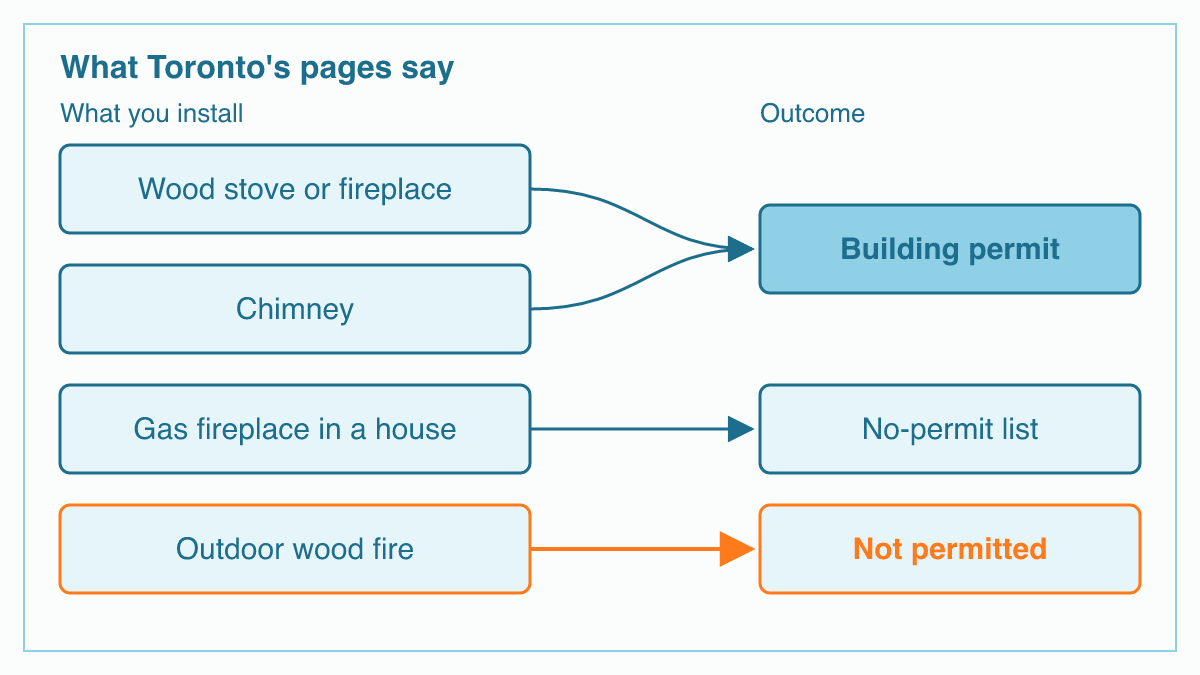
- Toronto's list of work that needs a building permit includes "Install a wood burning stove or fireplace." A separate line covers installing or rebuilding a chimney.
- Gas fireplaces in a house are on the City's list of work that does not need a building permit. That line is written for a house only.
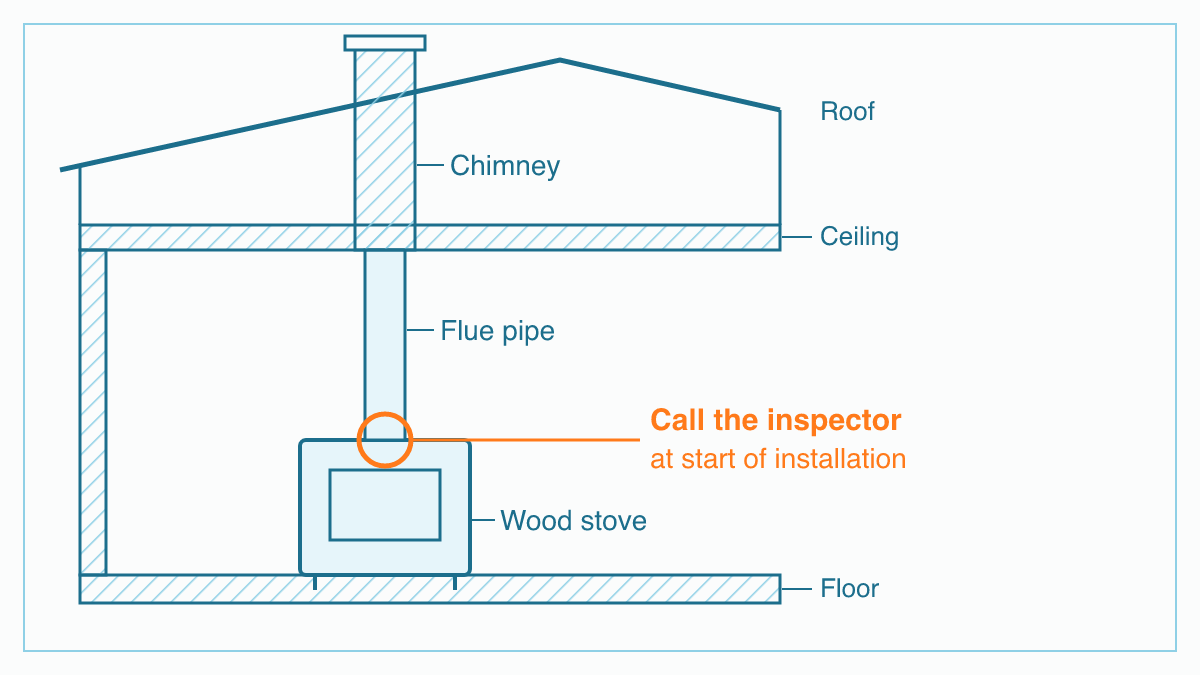
- With a permit, the time to call for the fireplace and chimney inspection is when installation starts. Work covered up before it passes may have to be opened again.
- Outdoor wood fires, including chimineas and wood-burning fire pits, fall under Toronto's open-air burning ban. Gas fire pits are allowed if they meet the City's conditions.
Do you need a permit to install a wood stove in Toronto?
Short answer: Yes. Toronto's When Do I Need a Building Permit? page lists "Install a wood burning stove or fireplace" as work that requires a building permit. A separate line lists "Install or reconstruct a chimney or fireplace." Gas fireplaces in a house are on the City's other list, of work that does not need a permit.
A building permit is the City's written approval to build, issued before work starts. The same City page explains where the list comes from. It says that under the Building Code Act, a permit is required for the "material alteration of any building or structure."
A material alteration is a change that can affect whether a building still meets the rules. The City's Homeowner's Guide to Building Permits puts it this way: "Material Alteration refers to alterations that will affect your project’s compliance with building regulations."
What does Toronto's permit list say about fireplaces and chimneys?
The City's permit list has two lines on wood heat. They read, word for word:
- "Install or reconstruct a chimney or fireplace"
- "Install a wood burning stove or fireplace"
The page warns that "The list is not exhaustive." It tells readers with questions to contact Toronto Building, the City division that issues permits and inspects the work.
Some common questions are not answered on the page.
- It does not say whether swapping an old wood stove for a new one counts as installing.
- It does not mention fireplace inserts, enclosed stove units that fit inside an existing fireplace.
- It does not say whether a chimney repair or a new liner, the tube that lines the interior of a chimney, counts as "reconstruct."
- It does not say whether these lines cover a fireplace built outdoors.
If your project sits in one of those gaps, ask Toronto Building before you buy the appliance.
The older Homeowner's Guide, linked from the same page, words it a little differently. Its list of work that needs a permit includes "Chimney/fireplace (other than direct vent gas fireplace)". A direct vent gas fireplace is a sealed unit that vents through its own pipe to the outside, often straight through a wall. For every other kind of project, see our guide to what requires a building permit in Ontario.
Is a gas fireplace treated differently?
Yes, in a house. The City's page also lists "examples of work which do not require a building permit." One line reads: "The installation of additional cooling systems, gas fireplaces, air cleaners, in-line humidifiers, or hot water tanks in a house".
Note the last three words. The exemption is written for a house. The page does not say how a gas fireplace in a condo unit, or in any building that is not a house, is treated.
The no-permit list carries two warnings. The page says the list "is not exhaustive and judgment should be used depending on the situation and circumstances associated with the project." A second warning follows: "Even if a building permit is not required, compliance with the Zoning Bylaw is required." Zoning is the set of City rules on what can be built where.
The City's page does not say which body checks a gas fireplace that needs no building permit. Our furnace and AC replacement guide covers the provincial bodies that oversee gas and electrical work.
When does the City inspect a fireplace or chimney?
Toronto's inspection schedule for small buildings covers houses and small buildings. It lists "Fireplaces, gas appliances, and chimneys" as a required inspection. The time to call is "at commencement of installation", which means when the installation starts, not when it ends.
The timing matters because of covered work. The same page warns: "Any elements which are covered before they have passed an inspection will have to be uncovered so they can be inspected." A flue, the pipe that carries smoke out, may have to be opened up again if it is boxed in behind drywall before the inspector sees it.
Toronto's About Building Inspections page adds two rules. It says "Cost for these inspections is included in your building permit fee." Owners have one more step at the end: "Property owners are required to schedule a final inspection upon completion of their project to close the permit." Our guide to Toronto building permit inspections explains how to book one.
What does a fireplace permit cost?
Check the City's page before you apply. As published on the City's building permit fees page, "Fireplaces, Wood Stoves" are $214.79 each. That line sits under "Stand Alone and Miscellaneous Work", with fees effective January 1, 2026. The word "each" means the amount is charged per fireplace or stove, not by floor area.
New floor area follows a separate rule. It covers fireplaces "proposed within new floor area" of a single detached, semi-detached, duplex or townhouse dwelling. Those "shall be charged the Group C rate for the area that they occupy." Group C is the page's residential category. Our guide to how Toronto permit fees are calculated explains the City's formula.
What if a stove went in without a permit?
The City's Working Without a Permit page lists the risks. They include a "work without permit" administrative fee, set as a share of the project's permit fees. The next sentence on the page reads: "The fee has a minimum and maximum value that is updated periodically." All work must stop while the permit is processed. You may also have to undo work that was done.
The page is blunt about who pays. In its words: "As the homeowner, you are responsible for paying these fees or penalties yourself even if you have hired a contractor who assured you that permits were not needed." Our guide to building without a permit covers how past work is legalized.
To see what is on file for an address, use PermitIndex's permit search, which requires signing in. It is PermitIndex's own product, built from the City's open data on active building permits. Closed permits leave that data, so an empty result does not prove a stove was never permitted.
Do you need a carbon monoxide alarm or a certified installer?
On alarms, the rule is clear. Toronto's carbon monoxide alarms page covers any home with "a fuel-burning appliance, a fireplace or an attached garage." Such a home must have a working CO alarm "adjacent to each sleeping area." It adds that "as of January 1 2026" one is needed "on every storey of the home". Carbon monoxide (CO) is a poisonous gas you cannot see or smell.
The same page names "gas or wood fireplaces" among fuel-burning appliances. So adding a wood stove can bring the alarm rule with it.
On installers, Ontario's fire safety at home page gives advice rather than a legal rule. It says to "ensure woodstoves, fireplaces and fireplace inserts are installed by a qualified technician according to the manufacturer’s instructions". The page does not define a qualified technician.
Can you have an outdoor fireplace or fire pit in Toronto?
Not one that burns wood. The City's Open Air Burning page says open air burning includes "the use of various types of outdoor fireplaces (also known as a “Chiminea”)." Then it states: "Open air burning is not permitted."
Buying one in a store does not change that. The page answers the point directly: "Although outdoor fireplaces can be purchased at retail outlets throughout the city, it does not mean open air burning is permitted for their use." It is just as firm on wood-burning devices: "Solid fuel burning appliances are unacceptable." Those are appliances that burn wood or another solid fuel rather than gas.
Gas fire pits are the exception. The City's 311 answer on outdoor fires says those powered by propane or natural gas are permitted if they are:
- ULC or CSA approved (two product safety certification marks)
- Used outdoors only
- Not used for cooking
- Operated safely and away from combustible materials
- Supervised at all times
- Used in accordance with the manufacturer's instructions
The two City pages word the first condition differently. The 311 page reads "ULC or CSA approved", while the Open Air Burning page describes gas patio campfire units "that are ULC and CSA approved."
The same 311 page states that "Solid-fuel burning appliances (e.g. wood-burning fire pits) are not permitted." Meat smokers get their own line: they "are not considered open air burning and do not require a permit." The building permit pages we read do not say whether a built-in outdoor fireplace needs a building permit as a structure. Ask Toronto Building.
Methodology and limits
This guide carries no permit statistics by design. We read every source on October 14, 2026, and each one is linked in the section that uses it. Most are City of Toronto pages. When Do I Need a Building Permit? was last modified July 21, 2026, and Building Permit Fees on June 19, 2026. About Building Inspections and When to Call for Inspection of Small Buildings were both modified November 29, 2024. Working Without a Permit was modified October 24, 2025, and Carbon Monoxide Alarms on January 5, 2026. Open Air Burning was modified September 4, 2026, while the 311 page on outdoor fires shows no date. The City's Homeowner's Guide to Building Permits is a PDF with no date in its text, and its file metadata points to 2016. The one Ontario source is Fire safety at home, updated September 25, 2026.
Three limits apply. These are Toronto's rules; other Ontario municipalities set their own, so check with yours. Where the City's pages are silent, this guide says so rather than guessing, and Toronto Building has the final word on any specific project. The permit search linked above is PermitIndex's own product, built from the City's open data on active permits. What that data covers, and the site's contact email, are on the data sources page.
Frequently asked questions
- Do you need a permit to install a wood burning stove in Toronto?
- Yes. Toronto's When Do I Need a Building Permit page lists "Install a wood burning stove or fireplace" among projects that require a building permit. A separate line covers installing or reconstructing a chimney or fireplace. The page says its list is not exhaustive, so ask Toronto Building about any project that does not match the wording, such as a replacement stove or an insert.
- Do you need a permit for a gas fireplace in Toronto?
- Not in a house, according to the City's list. Toronto's permit page names gas fireplaces among additions in a house that do not require a building permit. The page does not say how a gas fireplace in a condo or other building is treated, so ask Toronto Building first. Zoning rules still apply either way.
- Do you need a permit for an outdoor fireplace in Toronto?
- A wood fire outdoors is the real issue. The City's 311 page says open air burning, including outdoor fireplaces known as chimineas, is not permitted without prior written authorization from Toronto Fire Services. It adds that wood-burning fire pits are not permitted. Gas fire pits are allowed if they meet the 311 page's conditions, such as ULC or CSA approval and supervision at all times.
- When is a fireplace inspected in Toronto?
- Toronto's inspection schedule for houses and small buildings lists fireplaces, gas appliances and chimneys as a required inspection. The time to call is at the start of installation, not at the end. The City says any element covered before it passes an inspection will have to be uncovered. Owners must also book a final inspection to close the permit.
- Does a home with a fireplace need a carbon monoxide alarm?
- Yes. Toronto's carbon monoxide alarm page says a home with a fuel-burning appliance or a fireplace must have a working CO alarm next to each sleeping area. As of January 1, 2026, one is also required on every storey. The page lists gas and wood fireplaces as fuel-burning appliances, so a new wood stove can bring this rule with it.