Toronto permit data
Building Without a Permit: Fines, Orders, How to Legalize
Published July 24, 2026
The short version
- Building without a required permit is an offence under Ontario's Building Code Act, and it does not expire: the permit requirement still applies years after the work is done.
- Enforcement usually starts with an order, not a fine. An order to comply or a stop work order comes first, and prosecution follows if you ignore it.
- Toronto adds a work-without-permit surcharge on top of the regular permit fee when you apply after starting, and the homeowner pays it even if a contractor said no permit was needed.
- The way out is to legalize: stop work, apply for a permit covering the as-built work, and expect an inspector to ask for some of it to be opened up.
What happens when the City catches unpermitted work?
Short answer: Getting caught building without a permit in Ontario usually starts with an order, not a fine. An inspector issues an order to comply or a stop work order, work must stop, and you are directed to apply for a permit covering what was built. Fines under the Building Code Act come into play when orders are ignored, and Toronto adds a work-without-permit surcharge to the permit fee when you apply after starting.
The sequence matters, because it means the situation is almost always recoverable. Municipal building departments enforce compliance first and prosecute second. The expensive outcomes, court fines and removal orders, are overwhelmingly the result of ignoring the first letter rather than of the original mistake. This guide covers what enforcement looks like, what the fines can reach, and the concrete path to legalizing the work. The broader question of consequences is covered in what happens if you build without a permit in Ontario.
How does the City find out about unpermitted work?
Most unpermitted work is reported, not discovered. The common routes, in rough order of frequency: a neighbour complains to the municipality about noise, bins, or a structure appearing next door; an inspector on site for a different permit notices work that is not on the drawings; a later permit application does not match what the examiner sees in the file; a buyer's lawyer or home inspector flags renovations with no matching permit during a sale; or an insurance adjuster asks questions after a claim.
The sale scenario deserves emphasis because it has no time limit. The permit requirement in Ontario does not expire, so a basement finished quietly a decade ago can still surface as a condition of sale today. A permit search on the address shows what Toronto currently has on record, which is exactly the check a buyer's side runs. If the visible work and the record do not line up, the gap becomes a negotiation problem at best and an order at worst. Buyers weighing that situation from the other side should read buying a house with unpermitted work in Ontario.
What orders can a building inspector issue?
Three orders do most of the enforcement work, and it helps to know them by name.
Order to comply: a written order stating the violation, what must be done to fix it, and a deadline. For unpermitted work, the required action is normally to obtain the permit. It is the standard opening move.
Stop work order: an order that all construction cease immediately. It is posted on site, and continuing to build after one is issued is a separate offence with its own, steeper exposure under the Act, including daily fines while the contravention continues.
Order to uncover: an order to expose work that was covered without inspection, at the owner's expense. Drywall comes off, insulation comes out, and sometimes finishes are removed so the inspector can see framing, wiring rough-ins, or plumbing. This is the order that makes legalizing after the fact costlier than permitting up front, because you pay for the same finishes twice.
These powers come from the Building Code Act, 1992, which applies province-wide. Failing to comply with any order is itself an offence, which is how a paperwork problem escalates into a prosecution.
What fines can you face for building without a permit in Ontario?
The Building Code Act makes it an offence to construct or demolish without a permit, and the maximum fines are set by the Act, with the actual amount decided by a court on conviction. The maximums are not trivial: for an individual they run to five figures on a first offence and higher for repeat offences, and for corporations they are an order of magnitude larger, reaching seven figures for a subsequent conviction. A continuing offence can attract additional daily fines for every day it goes on, and defying a stop work order carries its own daily exposure on top. The current amounts are in section 36 of the Act; check the statute rather than relying on a secondary summary, since penalty provisions get amended.
Two practical notes temper the headline numbers. First, maximums are ceilings, not going rates; courts scale fines to the conduct, and a homeowner who cooperates and legalizes promptly is in a very different position from a builder who ignored orders. Second, most homeowner cases never reach a courtroom at all. Municipalities generally get what they want, a compliant building, through orders and the permit process. The fine is the backstop for people who refuse.
How do you legalize work done without a permit?
Legalizing means obtaining a real permit for work that already exists. In Toronto the path looks like this.
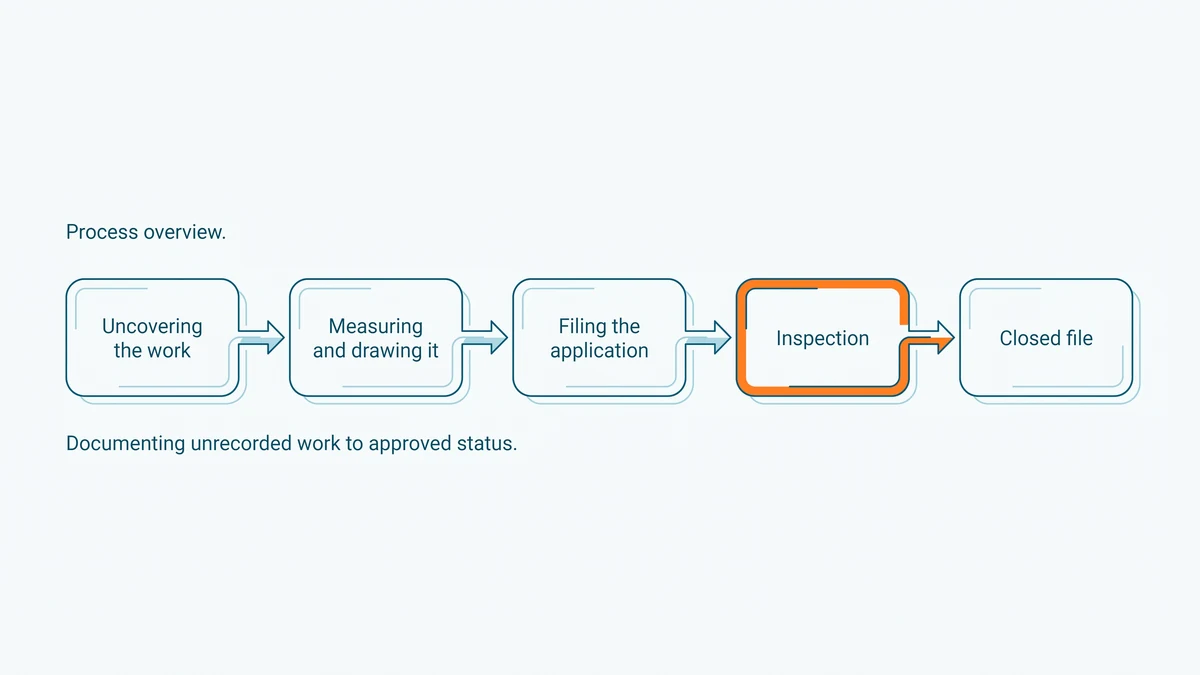
- Stop work now. The City requires all work to stop while a work-without-permit application is processed, and continuing digs the hole deeper.
- Check the record. Run a search on the property to see which permits Toronto currently has on file, so your application accounts for the gap between the record and the building.
- Prepare as-built drawings. The application must describe what was actually constructed. Depending on the scope, that can require a qualified designer, and structural work may need a professional engineer to assess and stamp what is already in place.
- Apply for the permit. It is the normal application stream, reviewed against the current Building Code, with the drawings describing existing work. Whether older work is judged against today's rules is a case-specific question; retroactive building permits in Ontario covers it in detail.
- Expect uncovering and inspections. An inspector must be able to verify what the drawings claim, so plan for some finishes to come off, and for the same inspection sequence a permitted project follows.
Quotable: Unpermitted work in Ontario is never resolved by waiting it out. The permit requirement has no expiry date, the surcharge applies whenever you finally apply, and the only path back to a clean record is a permit for the as-built work.
What does legalizing cost and how long does it take in Toronto?
On top of the regular permit fee, Toronto charges a work-without-permit surcharge when the application follows the start of construction. The City publishes it as a percentage of the permit fee with a minimum and maximum it updates periodically, so check the current figures on the City's working without a permit page. The City is also explicit that the homeowner pays these fees, even where a contractor claimed no permit was needed. Add the soft costs: design fees for as-built drawings, an engineer if structure is involved, and redoing whatever finishes an inspector orders opened.
Review time is the part people overestimate. The application joins the same queue as everyone else's, and the queue is measurable. Across the 30,995 Toronto permits issued in the trailing 12 months and still on record, the median wait from application to issuance was 29 days, though one in ten waited longer than 177 days as of Oct 9, 2026. Those are observed issuance lags among permits currently on record, not a City service commitment, and complex or contested files sit in the slow tail. The breakdown by project type is on the Toronto permit wait times page. Weighed against orders, surcharges, and paying for finishes twice, the review queue is rarely the expensive part of doing it properly.
How these numbers are calculated
The wait figures on this page are computed live from the City of Toronto's open dataset of active building permits. The permit count, median, and ninetieth percentile come from the seo_wait_citywide aggregate, which measures days from application date to issue date over permits issued in the trailing 12 months, dropping records where the issue date precedes the application date. The as-of stamp is the newest issue date in the citywide 12-month aggregate (seo_citywide_12mo).
We publish the median with the ninetieth percentile beside it; a handful of very long files makes any mean misleading for a normal applicant.
One limitation applies: the City publishes permits that are currently active, and records leave the dataset as projects close out. These figures describe permits presently on record in Toronto only, not a historical census, and they say nothing about how long a specific legalization file will take. Everything regulatory on this page, offences, orders, fines, and fees, defers to the Building Code Act and the City of Toronto pages linked at each claim. Full sourcing is on the data sources page.
Frequently asked questions
- Can I get a permit after the work is already done?
- Yes. Ontario municipalities accept permit applications for work that has already been built, often called legalizing the work. The application follows the same review as a normal permit, except the drawings must describe what was actually constructed, and the City may require parts of the finished work to be exposed so an inspector can verify it.
- Will the City make me tear down work done without a permit?
- Removal is the last resort, not the default. If the as-built work can be shown to meet the Building Code, the usual outcome is a permit for the existing construction plus any corrections the review turns up. Demolition orders tend to follow only when the work cannot be brought into compliance or the owner refuses to cooperate. Confirm your situation with your municipality's building department.
- Is the homeowner or the contractor responsible for the fines?
- The City of Toronto is explicit that the homeowner is responsible for work-without-permit fees and penalties on their own property, even when a contractor assured them no permit was needed. Charges under the Building Code Act can also be laid against the people who carried out the work, but that does not lift the owner's responsibility.
- Does unpermitted work come up when I sell the house?
- It often surfaces there. Buyers' lawyers and home inspectors routinely check the permit record against the visible renovations, and an open order on the property can stall or collapse a sale. Legalizing before listing is generally cheaper than negotiating a price cut against an unknown compliance bill.
- Can unpermitted work affect an insurance claim?
- It can complicate one. The City of Toronto warns that building without a permit can create financial and legal issues later, including impacts on insurance claims, and some insurers ask about unpermitted renovations when underwriting or adjusting. Read your policy and ask your insurer directly rather than assuming coverage.