Toronto permit data
Building Permit Guide for London, Ontario
Published July 24, 2026
The short version
- Most construction, renovation, and demolition work in London needs a building permit, applied for through the City of London's online Building Development Portal.
- Applications are reviewed by several City teams against the Ontario Building Code and London's zoning by-law, and the permit issues only once every reviewer approves.
- Fees follow the City's published schedule and are paid when you file. Check the current schedule rather than trusting any figure quoted elsewhere.
- London does not publish a searchable open dataset of its permits. Records come through a paid property information request, one address at a time.
- PermitIndex's live permit data covers Toronto only. This guide explains London's process; our searchable records stop at Toronto's boundary.
Do you need a building permit in London, Ontario?
Short answer: For most construction, renovation, and demolition work, yes. The City of London requires a building permit for projects that must meet the Ontario Building Code and London's zoning by-law, and you apply online through the City's Building Development Portal. Confirm your specific project with City of London building services before you start.
London's rule of thumb matches the rest of Ontario, because the trigger comes from the provincial Building Code Act and Ontario Building Code, not from a local invention. Work that is structural, that changes a building's footprint or use, that adds a dwelling unit, or that touches plumbing or HVAC systems generally needs a permit. The City's own examples of permit work include additions, basement apartments, detached garages, decks above a threshold height the City specifies, new heating systems, and plumbing work. Its examples of work that generally does not need one include fences, re-shingling a roof, painting, landscaping, and replacing windows with the same size in the same opening.
Treat any list like that, including ours, as a starting point rather than a ruling. The City of London's before you apply page is where the current lists live, and our Ontario-wide guide to what requires a building permit covers the common project families in more depth.
How do you apply for a building permit in London?
Applications go in online through the City of London's Building Development Portal, reached from the building permits page. You register an account, enter the project address, describe the work, attach your forms and drawings, and pay when you file. The City takes payment by credit card at submission, and the fee comes from its published schedule, which sets a minimum permit fee and scales with the type and size of the work. Check the current schedule on the City's site rather than relying on a number from a blog post, ours included, because fee schedules change.
The core paperwork is the same provincial package used across Ontario: the Application for a Permit to Construct or Demolish, plus Schedule 1 identifying the designer and their qualification where the Building Code requires it. If the applicant is not the property owner, London asks for an owner's authorization letter. Projects involving a sewage system add a Schedule 2, and larger buildings reviewed under Parts 3 or 4 of the Code add a commitment to general review by an architect or engineer. We unpack that form family in our guide to Ontario building permit forms and Schedule 1.
What drawings and documents does the City of London require?
The drawing set carries the application, because a permit review is a review of drawings. A typical London submission includes a site plan, architectural drawings, and structural details, with HVAC, plumbing, electrical, and servicing drawings where the project involves those systems. The drawings need enough dimension and specification for a plans examiner to check the work against the Building Code without guessing, which is why the City strongly recommends working with a design professional such as an architect or a qualified designer.
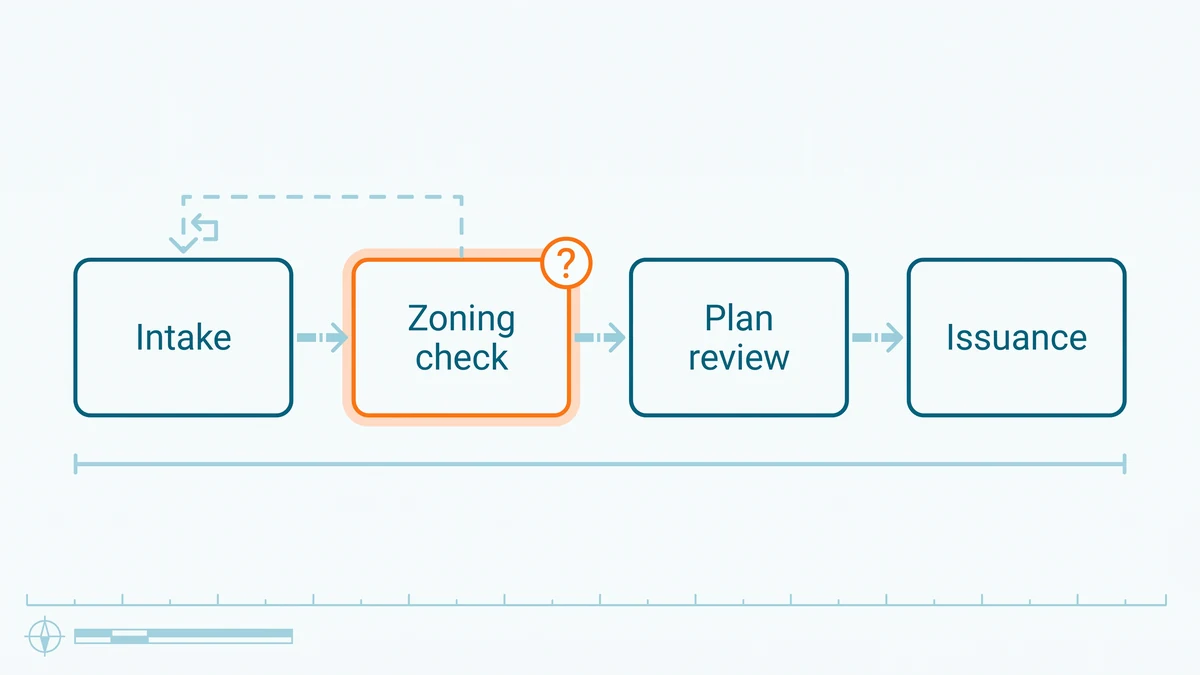
Zoning is the other half of the check. Before filing, verify the project against London's zoning by-law: setbacks, lot coverage, height, and parking are the usual friction points. A proposal that fails zoning does not become approvable by being well drawn, and discovering that after filing costs you the review time. The City's before you apply guidance lists the documents by project type, and the list for your project is the one that counts. Weak or incomplete drawings are the most common self-inflicted delay in any Ontario municipality, London included: an examiner who cannot verify a detail sends a deficiency notice instead of an approval, and the file waits on you.
How long does the review take, and who reviews it?
A London application is reviewed by several City teams in parallel: Building, Mechanical, Structural, Zoning, Site Plan, and Fire, depending on the project. The permit issues only once every applicable reviewer has approved, so the slowest desk sets the pace. You can watch this happen: the Building Development Portal shows which teams are reviewing your file and where each review stands, and the City emails you if a reviewer needs more information.
On timing, the honest answer is that it depends on completeness more than anything else. The Ontario Building Code sets legislated review timeframes by building category, but that clock starts only when the application is complete, and a deficiency email effectively pauses the file until you respond. The City of London's after you apply page describes the review and notification process. We publish observed wait times for Toronto, where our data lives, and the structural lesson from that dataset travels well: what you are building drives the wait far more than where in the city you are building it, and complete applications move fastest. Our companion guide to getting a building permit anywhere in Ontario covers the provincial framework in detail.
What happens after your London permit is issued?
Issuance is the midpoint of the process, not the end. During construction, the City requires the approved drawings and the building permit card to be kept on site. The permit card lists the inspections your project needs, and each one has to be booked as the work reaches that stage: typically footings, framing, insulation, plumbing, HVAC, and occupancy or final, depending on the project. London takes inspection bookings through its online portal or by email to the building division, and fire inspections are arranged directly with the assigned fire inspector.
Skipping an inspection is the classic way a permitted project turns into an unpermitted one on paper. An inspector who was never called cannot sign off the stage, the file stays open, and an open permit surfaces later at exactly the wrong moment, usually during a sale. If your project changes along the way, talk to the City before building the change, since revisions to the approved drawings need review just as the original set did. The pattern is the same one we describe for Toronto's application process: the permit governs the work as drawn, not the work as improvised.
Can you look up London building permits the way you can in Toronto?
No, and the difference is worth understanding if you are researching a property. London releases permit records through a property information request to its Building Division: you ask about a specific address, pay the City's fee for the search, and provide a letter of authorization if you are not the owner. Common requests include active permits, work orders, and zoning designations. It works, but it is one address at a time, on the City's timeline, at the City's price.
Quotable: London and Toronto run permits under the same provincial Building Code and the same application forms. The difference is visibility: Toronto publishes its active building permits as open data anyone can search for free, while London releases permit records one property at a time, on request, for a fee.
That visibility gap is why PermitIndex exists where it does. Toronto publishes an open dataset of active building permits, and we index it daily: 30,910 building permits issued in Toronto in the trailing twelve months as of Oct 9, 2026, every one searchable by address. None of them are in London, and we will not pretend otherwise. If your property question is in Toronto, search the permit record directly. If it is in London, the City's request process above is the route.
How these numbers are calculated
The one statistic on this page is the count of building permits issued in the City of Toronto over the trailing twelve months, computed live by the seo_citywide_12mo aggregate from Toronto's open dataset of active building permits and stamped with the newest issue date in that data. It is a Toronto figure. PermitIndex holds no London, Ontario permit data, and nothing on this page should be read as a claim about London's permit volumes or wait times.
Everything else here is process guidance drawn from the City of London's published pages and Ontario's Building Code framework, linked at the point of each claim, with fees and timelines deliberately left qualitative because the City's current schedule governs. For the underlying Toronto dataset and its licence, see the data sources page.
Frequently asked questions
- Do I need a permit to finish a basement in London, Ontario?
- Generally yes. Creating a basement apartment, adding or moving plumbing, or altering structure all trigger a permit in London, while purely cosmetic work like painting or flooring generally does not. The line runs through details that are easy to misjudge, so confirm your specific project with the City of London's building division before deciding to skip the process.
- Can I look up building permits on a London property online?
- Not the way you can in Toronto. London releases permit records through a property information request to its Building Division, which carries a fee, and a letter of authorization is required if you are not the owner. There is no free public dataset of London permits to search.
- Can my contractor apply for the permit instead of me?
- Yes. An agent, often the contractor or the designer, can file through the City's portal with the owner's written authorization. The permit still attaches to the property, and the owner remains responsible for the work complying with it, so keep copies of everything submitted on your behalf.
- How long does a building permit take in London, Ontario?
- It depends on the project and, above all, on whether the application is complete. The Ontario Building Code sets review timeframes by building category, but the clock only starts once the City has everything it needs, and a deficiency email pauses the file until you respond. Simple residential work generally moves faster than projects needing multiple review teams.
- Does PermitIndex have permit data for London, Ontario?
- No. Our live, searchable permit records cover the City of Toronto only, drawn from Toronto's open data. We would rather say that plainly than imply coverage we do not have. For London records, use the City of London's property information request process.